
















No products in the cart.

Shop this story
Tesla’s robotaxi sprint exposes an autonomy gap for legacy OEMs
by Joseph L
Autonomy is shifting from a technical curiosity to the organizing principle of long term product and profit strategy in automotive. The next decade will not be decided by who ships the next electric SUV, but by who can convert software centric driving systems into scalable, regulated mobility businesses. For strategy leaders, the uncomfortable reality is that the market is starting to reward bold bets on autonomy, even as the operational and regulatory foundations remain incomplete. That tension is where competitive distance can rapidly widen, or collapse.
Against this backdrop, the Tesla Robotaxi strategy is emerging as a reference point for cost structure, pace of deployment, and data driven learning, regardless of whether you agree with its timelines. The company is using a simplified sensor philosophy, high volume manufacturing, and aggressive capital signaling to position robotaxis as a primary value engine rather than a side program. This article examines how that play exposes an autonomy gap for legacy OEMs, by contrasting technical architecture choices, market expansion postures, risk and regulatory approaches, and the timing assumptions that now shape investor and board expectations.
Camera-only autonomy: Tesla’s cost-and-data advantage
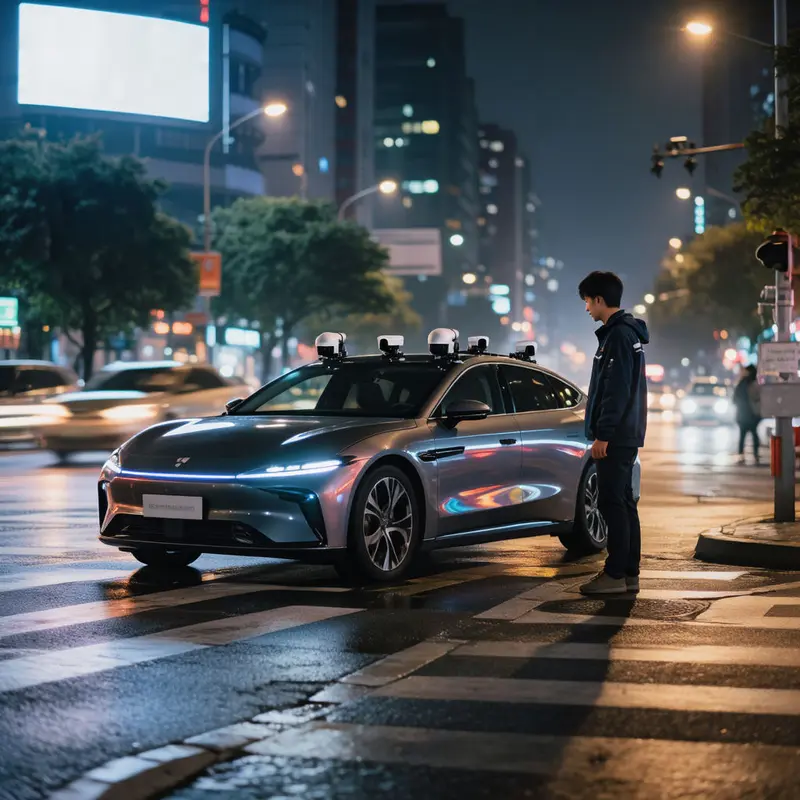
Tesla’s move to pursue camera-only autonomy isn’t a quirky engineering preference. It’s the core of a cost, scale, and data strategy that every automotive strategist now has to benchmark against.
By 2026, MotorTrend named Tesla’s camera-only Full Self-Driving (FSD) the top driver assistance system for fair-weather conditions. That recognition didn’t just validate software quality. It showed that cameras, when backed by strong vision models, can reach performance levels that many assumed required expensive sensor stacks.
Hyundai’s internal testing backed this up. In its own comparisons, Hyundai ranked Tesla’s FSD above its in-house system and other rivals, especially on the strengths of the camera-only approach. For a legacy OEM, that’s the uncomfortable part. Tesla’s proving that a simplified sensor suite can outperform more traditional, hardware-heavy designs.
Then Tesla went further and turned the architecture into a business. By early 2026, it launched an unsupervised Robotaxi service in Austin that ran on this camera-based stack. That move showcased two strategic benefits at once: it reinforced how a focused AI-powered business strategy can turn a technical architecture into a scalable service model, and it highlighted that cameras cut per-vehicle hardware cost and simplify service, while the software can be deployed and iterated across a growing fleet with minimal physical reconfiguration.
If you’re evaluating Tesla’s Robotaxi strategy, three elements deserve close scrutiny:
- Cost structure. Camera-only systems avoid LiDAR and reduce sensor complexity, which can support lower vehicle BOM and faster fleet scaling.
- Scalability and deployment. The Austin Robotaxi launch shows how quickly a software-centric stack can be rolled out as long as vehicles already carry the required cameras.
- Data engine. Every additional camera-only car or Robotaxi becomes a data node, feeding the same perception architecture and accelerating model improvement.
This edge doesn’t come without friction. Tesla’s FSD experienced real-world camera fogging from condensation. That issue hit reliability until Tesla implemented sealing upgrades and cleaning systems. The episode is a blunt reminder that a camera-centric stack lives or dies by optical uptime, which has to be managed at both design and operations levels.
Sensor strategy also stays contested in the broader market. A 2026 United States survey found that 70 percent of respondents prefer vehicles that use both cameras and LiDAR. Research also indicates that alternative sensor fusion can reduce errors by 70 percent. For legacy OEMs, this dual reality creates a strategic dilemma. Consumers and some engineers lean toward redundancy, while Tesla shows that a leaner package can still hit key performance milestones.
Tesla’s 2026 shift to a 99 dollar per month FSD subscription, replacing the 11,000 dollar one-time fee, further tightens the loop between technology and business model. Lowering the upfront cost expands the installed base, which increases data volume for the camera-only stack and supports faster iteration. Strategically, Tesla’s trading per-unit software margin for fleet-wide learning speed.
For you as a strategy leader, the takeaway’s direct. Camera-only autonomy isn’t just a technical choice for Tesla. It underpins a lower-cost, faster-learning Robotaxi platform that’s already operating in a major United States city. How might that edge compress your timelines and shift your expected cost curves? Answering that question is the critical first step before we examine how the market for Robotaxi services is set to expand and intensify the race for dominance.
Market expansion race: Tesla’s aggressive robotaxi land grab
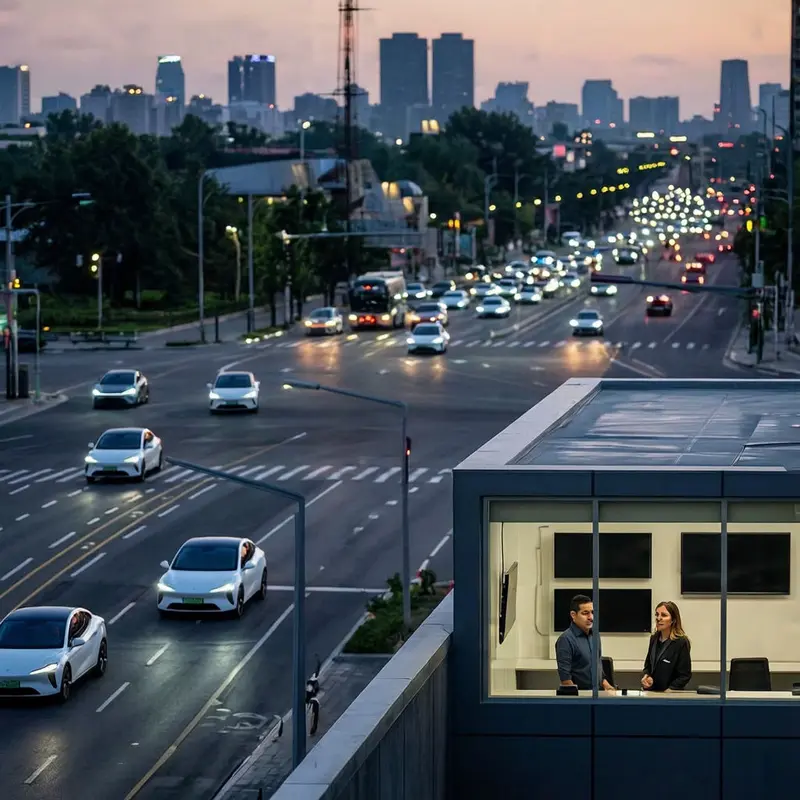
That cost and learning advantage you just examined does not sit in a vacuum. It sets the stage for an aggressive land grab as Robotaxi markets move from concept to scaled reality.
For you as an automotive strategy executive, the question is no longer whether Robotaxis will matter. It is how fast the market can expand and who locks in the dominant position as it does. Tesla is already treating Robotaxis as the core of its future enterprise value, with expectations that roughly 90% of the company’s worth by 2029 will be tied to autonomous services. That focus is anchored in a projected $10 trillion revenue opportunity from Tesla Robotaxi value projections, which turns autonomy from a side bet into the main business.
Tesla’s Robotaxi strategy is now shifting from thesis to deployment. The planned pilot in Austin, built on Model Y vehicles and owner-shared fleets, is a critical proof point. It tests not only technical performance but also the economics of asset-light scaling, where private owners share vehicles into a network rather than Tesla carrying all fleet capex on its own balance sheet.
Scale is the second structural lever. Tesla already produces over 5,000 vehicles daily and aims for 1.77 million vehicle deliveries in 2026, with 8.2% year-over-year growth. Pair that with Cybercab production starting in April 2026, and you get a manufacturing base that can swing quickly toward Robotaxi-optimized hardware once the unit economics are confirmed.
Then comes the data flywheel. Tesla collects 40 times more driving data than Waymo, while also operating with lower costs than competitors. For a learning-limited domain like autonomy, that translates into faster model improvement and a lower marginal cost per incremental city or route.
This is why Tesla’s Q4 2025 revenue of $24.9 billion matters for you. It shows a company with the financial muscle to fund an accelerated rollout, even as legacy OEMs are still calibrating their commitment. The next step is to understand how Tesla’s deployment posture compares with Waymo’s, and how those contrasting strategies will shape the speed and pattern of market expansion. Where do you want your organization to sit when that happens?
Tesla vs Waymo: Diverging risk postures in robotaxi rollouts
You just saw how capital strength shapes rollout speed. Now you need to recognize that money is only half the story. The other half is how aggressively you’re willing to put real customers into autonomous service.
Seen through that lens, Waymo and Tesla sit at opposite ends of the deployment spectrum. Waymo runs about 200 fully driverless vehicles and has already delivered over 14 million paid rides in 2026. Those numbers describe a company treating autonomy as a live, scaled product, not a perpetual pilot, with implications that echo broader debates about the future of AI finance and infrastructure.
Tesla, by contrast, is still in a tightly controlled phase. It runs approximately 30 supervised vehicles in select areas. Every ride is effectively a test, not yet a broadly marketed transportation service.
If you’re an automotive strategy executive, the core question isn’t who’s “ahead” in technology. It’s what each approach signals about risk appetite, regulatory posture, and go to market timing.
Here are three practical contrasts that should shape your own roadmap:
- Level of human oversight. Waymo doesn’t use safety drivers in cities like Phoenix, San Francisco, and Miami Airport. Tesla’s deployment remains supervised, which keeps risk lower but also slows learning from large scale customer use.
- Service maturity. Waymo’s millions of paid rides signal an operational focus on reliability, routing, and fleet management at scale. Tesla’s smaller fleet is still building the operational playbook in real environments.
- Pricing posture. Tesla’s rides cost about $1.99 per km, while Waymo’s cost about $5.72 per km. Tesla’s Robotaxi strategy is signaling a push toward mass market affordability. Waymo is prioritizing coverage and robustness in a smaller, premium priced footprint.
The synthesis is straightforward. Waymo’s proving that regulators and riders will accept fully driverless service at modest scale, while Tesla’s refining a cost structure that, if validated, could trigger rapid volume growth. Your strategic task is to decide whether to emulate Waymo’s stepwise, city specific validation, or Tesla’s bet on disruptive pricing. The next chapter examines how Elon Musk’s public timelines and market claims should influence the urgency and pacing of your own autonomy commitments.
Elon Musk’s predictions: Recalibrating your autonomy clock

You just weighed whether to follow Waymo’s methodical, city-by-city rollout or Tesla’s aggressive, cost-led push. Now you have to decide how seriously to take Elon Musk’s timing claims and how hard they should pull on the pacing of your own autonomy bets.
Musk keeps talking in near-term horizons for scale. He predicts a widespread U.S. driverless robotaxi network by the end of 2026, a milestone that has already drawn extensive analysis of Musk’s 2026 robotaxi prediction. In parallel, Tesla has already shifted its Austin robotaxi pilot into operations without safety monitors, and those unsupervised runs are speeding up its local learning cycle. For a strategy executive, the signal is not the bravado. It’s that Musk is tying Tesla’s product, capital, and talent plans to a calendar measured in quarters, not decades.
You can see Tesla’s execution blueprint in its expansion plan. The company intends to extend robotaxi operations from Austin to five new U.S. markets by 2026, including Las Vegas, Phoenix, Dallas, Houston, and Miami. That roadmap, combined with a camera-only perception stack, lets Tesla expand without pre-mapping each city in lidar-level detail. In practical terms, the Tesla Robotaxi strategy trades some early conservatism for speed and geographic reach.
You can plot Musk’s timing against the broader market canvas. The robotaxi market is projected to grow at a 99% compound annual growth rate through 2033, and autonomous vehicle sales could reach roughly $3 to $3.3 trillion annually by 2040. At the same time, Tesla’s humanoid robot, Optimus, is positioned to drive as much as 80% of the company’s valuation, in a humanoid robot market that’s estimated to grow at 50% CAGR to about $1.2 trillion by 2040. Musk is telling capital markets that autonomy and robotics are not side bets. They’re the growth engine.
This creates both urgency and risk for any incumbent. The EV market is currently facing a 9% decline, which already stresses growth narratives, and Tesla trades at high multiples, including roughly 133x EV over EBITDA. Those valuation levels suggest that public markets are already partially pricing in Musk’s timelines. If you assume similar timeframes for your own planning, you have to be ready for the same scrutiny.
To convert Musk’s predictions into an actionable calendar, you should treat them as a pressure test, not a forecast. Ask three questions. First, if Tesla does achieve a multi-city driverless network by 2026, which of your core profit pools come under immediate attack? Second, if the robotaxi and humanoid markets ramp anywhere near current projections, which capabilities must you fund now to avoid being locked out later? Third, if Musk slips by several years, can you still justify your own autonomy capex against a 9% EV market decline and more conservative multiples?
In practice, Musk’s timelines force a portfolio view. Near term, they argue for targeted pilots in strategically exposed cities, paired with disciplined gating of capital until regulatory and utilization data improve. Longer term, they suggest that autonomy and humanoid robotics need to appear explicitly in your 2040 profit and loss scenarios, even if you choose not to match Tesla’s pace.
The key is to let Musk shape your sense of urgency without dictating your sequencing. His predictions anchor the upside that markets are already partially pricing in, but your board will also judge you on how well you navigate the regulatory, safety, and permitting realities that can stretch or compress those timelines. That’s where we go next, as we look at how regulatory hurdles and policy roadmaps will shape what’s actually achievable in autonomy over the coming decade.
Regulatory hurdles and future roadmap as the new ceiling
Your board will not just ask when autonomy pays off. It will also ask whether regulators will actually let it happen on the timelines being advertised. That gap between vision and reality is where strategy gets decided.
Look at Tesla. Elon Musk first promised Tesla robotaxis would reach roughly half the U.S. population by the end of 2025, then the company scaled that goal back to just 8 to 10 metro areas. Since then, Tesla has given no update on whether even this narrowed ambition is still viable, underscoring unresolved questions about the broader ethical implications of AI in safety-critical, real-world deployment. As an executive, you should treat that silence as a live risk factor, not background noise.
Those shifting targets point to two linked issues:
First, there are real execution gaps for Tesla robotaxis compared with the public hype, especially around robust real-world performance that can withstand regulatory scrutiny.
Second, regulatory progress for Full Self-Driving and the Cybercab concept has stalled, which means there’s still no firm timeline for broad unsupervised deployment.
That leaves you with an awkward reality. Tesla has spent nearly a decade promising unsupervised deployment, yet regulators still have not granted a green light for wide-scale, unsupervised operation. With every year that slips, it gets harder for any OEM to credibly claim that autonomy at scale is just around the corner.
For your own roadmap, treat these signals as a forward-looking barometer. Regulatory delays are now a core barrier for Tesla. They also widen the autonomy gap for traditional manufacturers that lack comparable software maturity or data scale. If the most aggressive Tesla Robotaxi strategy is bogged down in approvals, how much more friction will legacy OEMs face?
Practically, this means three things for you:
- Build your business cases on supervised or constrained autonomy first, because broad unsupervised use has no reliable horizon.
- Engage regulators early and continuously. Don’t assume Tesla’s lobbying will clear the path for everyone.
- Use Tesla’s decade of unmet autonomy promises as a cautionary planning scenario, not a blueprint.
The practical takeaway is simple. Technical milestones alone won’t deliver autonomy at scale. The pace of regulatory comfort will set the ceiling. It’s already stretching timelines for the most assertive player in the field, and it will stretch them even more for everyone else.
Final thoughts
Taken together, the story is clear. Tesla is trying to bind a lean autonomy stack, a scaled manufacturing base, and an aggressive expansion calendar into a single flywheel, while regulators and real world performance keep pulling on the brakes. That combination creates a widening gap between what is technically and financially plausible for a software native player and what is feasible for incumbents that still rely on slower data loops and more conservative product cycles. At the same time, the regulatory ceiling is proving stubborn, which means that even the most assertive strategies must bend to the pace at which safety, ethics, and public trust evolve.
For automotive strategy executives, the practical implication is not to copy the Tesla Robotaxi strategy, but to use it as a stress test for your own roadmap. You need a clear view of where autonomy can reinforce existing profit pools under supervised or constrained use, where you will need partnerships or acquisitions to close capability gaps, and how you will engage regulators before capital is fully committed. The leaders of the next decade will be those who treat autonomy as a core strategic system, not a feature, and who plan for both rapid breakthroughs and drawn out approvals. The question now is whether your organization will treat this window as a chance to reset its trajectory, or let the autonomy gap harden into a permanent structural disadvantage.
Ready to take control of your financial future with smart strategies and expert insights? Contact OnInitiative.com ([email protected]) today and let our team help you make informed, confident decisions with data-driven financial solutions!
About us
OnInitiative.com is an innovative marketplace that helps e-commerce businesses boost productivity and community growth through advanced automation tools.
Further reading


Leave a comment