













No products in the cart.

Shop this story
5 renter-friendly upgrades that make a rental finally feel like yours
by Anabel Figueroa
Most apartments ask you to live with someone else’s choices, and renter friendly upgrades matter because that low-grade annoyance follows you every day. You see it when the walls feel blank, the lighting feels harsh, or the windows make privacy feel like a negotiation. After a while, the problem isn’t just style. It’s comfort, control, and whether home actually helps you exhale.
That tension gets tricky fast in a rental. Every change has to earn its keep, come back down cleanly, and make sense for a place you may leave in a year. The sweet spot is a fix that changes the room you live in now without creating a move-out problem later. That’s what makes the right upgrade feel so satisfying. It gives you more ownership of your space, even when you don’t own the space.
1) Peel-and-stick wallpaper: Smooth walls, fast personality
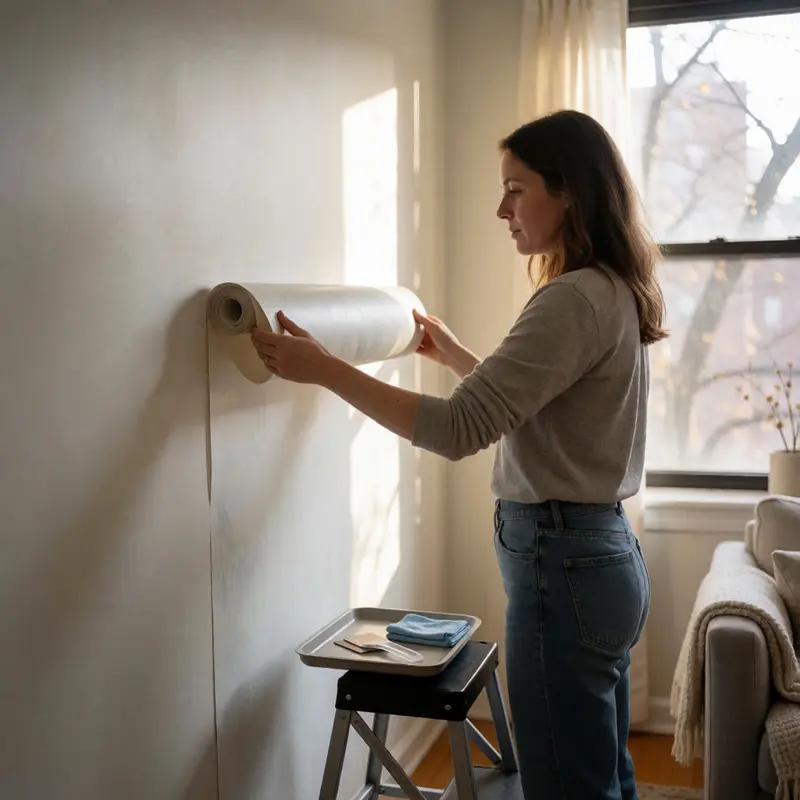
You sign a lease, move your furniture in, and then stand in the middle of a room that still looks like it did when a stranger lived there: flat white walls, no personality, no sense that anyone in particular chose this place. renter friendly upgrades start here, with the wall, because nothing else changes a room’s feeling as fast.
Peel-and-stick wallpaper works best on smooth, clean surfaces painted with fully cured paint. If your landlord recently repainted a wall, give it 4 to 6 weeks before you hang anything, because fresh paint hasn’t fully hardened and the wallpaper can pull the finish when you remove it. Before you apply a single strip, wipe the wall down with a 30/70 isopropyl alcohol and water mix. Grease, dust, or lingering moisture will work against the adhesive from day one.
Let the rolls sit in the room for 48 hours before you start. This matters more than it sounds. Wallpaper that acclimates to your room’s temperature and humidity will lie flatter and stay put longer. When you hang strips, overlap each one by about a thirty-second of an inch so small gaps don’t open up as the seasons shift.
The real obstacle most renters hit is surface texture. Orange peel, knockdown, roman clay, limewash, and bare cinderblock will all prevent the adhesive from bonding properly, and no amount of careful application fixes that. If your walls have a pronounced texture, skip the full wall and use the wallpaper on flat cabinet doors or drawer fronts instead.
In humid rooms, edges can lift over time, but you can press them back down with a hairdryer on a low setting to reseat the adhesive, or reinforce them with a thin line of wallpaper adhesive before they become a real problem. Smooth out bubbles with a credit card or plastic smoother as you go, working from the center of each strip outward.
One roll can do more than cover a single wall. Line shelves, wrap the sides of a bookcase, or cut a section and mount it inside a simple frame, and you get the color and pattern of wallpaper without committing to an entire accent wall.
2) Peel-and-stick floor tiles: A weekend floor reset
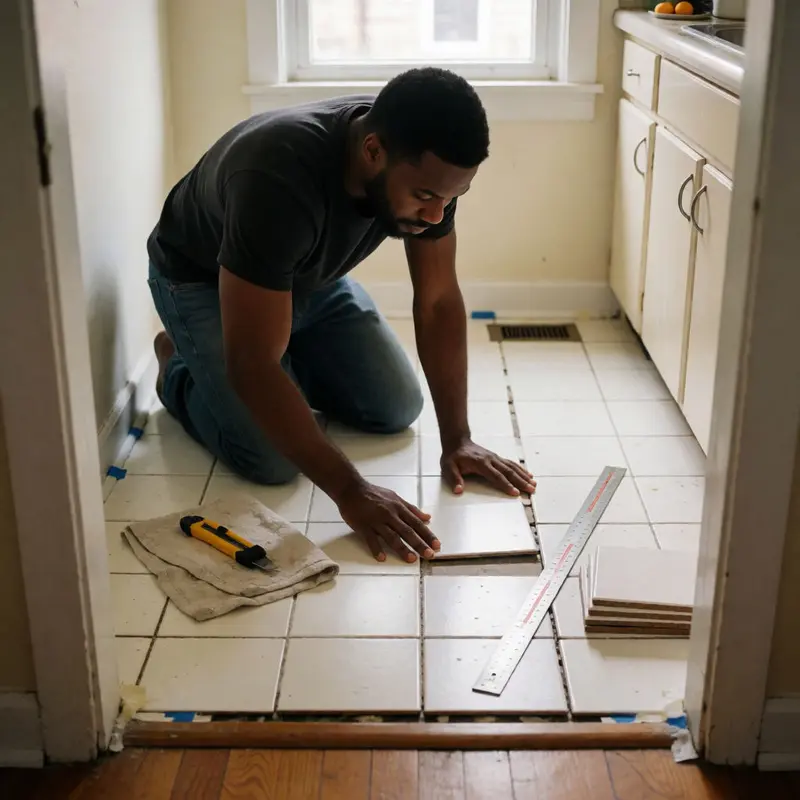
Floors are the one surface in a room you can’t avoid looking at, and in most rentals they’re the one you least chose. Peel-and-stick vinyl planks or tiles give you a practical way out of someone else’s beige linoleum or worn carpet, and the whole project fits into a weekend without a single power tool.
The range is wide enough to land on something you actually want: vinyl tiles that mimic stone, planks that read as wood, even carpet tiles for a bedroom corner. Whichever you pick, the floor underneath needs to be clean and as level as you can get it, because these thinner tiles can’t hide what’s underneath. Any meaningful bump or groove will eventually show through. Sweep, wipe down with a damp cloth, and let everything dry before you start.
Laying the tiles is straightforward. Peel the backing, press each piece down firmly, and use a hand roller along the seams to close any gaps between planks. Start from the center of the room and work outward, so the most visible area doesn’t end up with a sliver of tile. Plan for one limitation: adhesive can work loose in high-moisture areas over time, so a bathroom or a kitchen near the sink is a harder environment than a living room or bedroom.
If you’re working over carpet, the Apartment Therapy approach of laying thin plywood sheets first and then applying the planks on top keeps the whole thing stable and genuinely reversible. That extra step protects a surface your landlord will inspect, which is exactly what makes this one of the smarter renter friendly upgrades.
Rated to last 5-10 years under normal conditions, these floors outlast most lease terms by a meaningful margin. When you do move, take up the tiles carefully, and keep a small bottle of adhesive remover on hand for any stubborn spots. Leave the floor looking as close to the one you walked into as possible. The space you lived on in between still got to feel like yours.
3) Renter-friendly lighting swaps: Warm, layered light in minutes
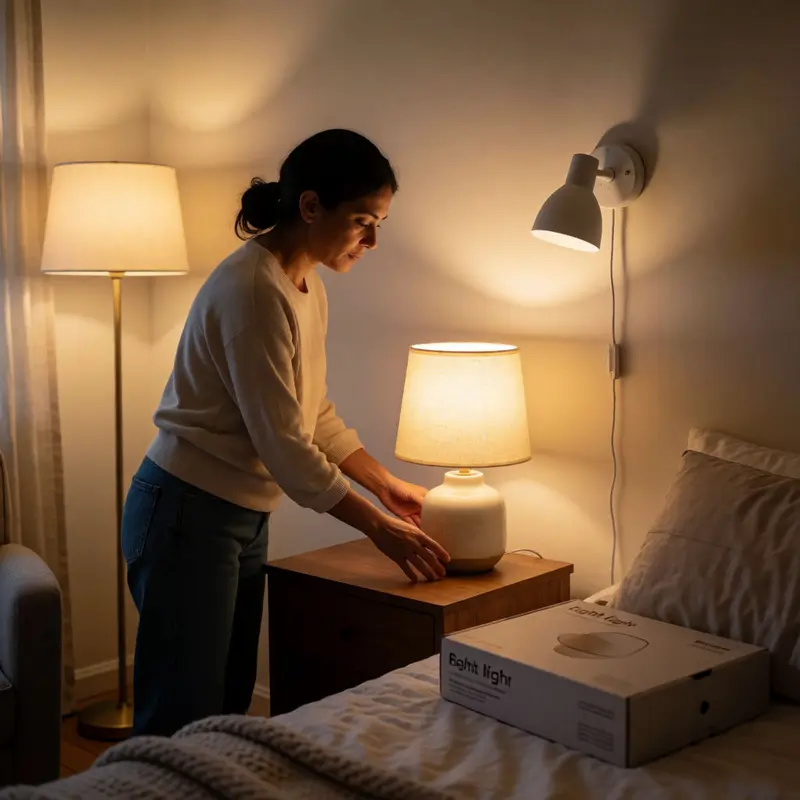
Bad rental lighting usually comes down to the same problem: one harsh overhead fixture in the middle of the ceiling, casting flat light that makes a room feel like a waiting area. The good news is you can fix most of it without touching the wiring.
The fastest move is to swap the bulbs already in your existing fixtures. LEDs use less energy than incandescent bulbs, last significantly longer, and come in warm tones that feel closer to candlelight than a hardware store. The U.S. Department of Energy frames this as the renter’s single highest-impact efficiency upgrade, and it takes about two minutes.
Beyond the bulbs, the real shift comes from adding layers. A single overhead source flattens a room. Multiple light sources at different heights and positions make the same square footage feel intentional. Plug-in pendants hung near a corner, a floor lamp angled toward a reading chair, a battery-powered sconce mounted beside a bed: each one adds a layer without touching a wall switch or running new wire. Wireless sconces in particular go up with hardware, come down the same way, and travel with you to the next apartment.
For smaller, darker spots, adhesive LED strip lights and puck lights do work no floor lamp can do: underneath cabinet shelves, around a bathroom mirror, inside a wardrobe. They peel off cleanly at move-out and take their glow with them.
What ties these renter friendly upgrades together is color temperature. Keeping your light sources under 3000K, what most bulb packaging labels as ‘warm white,’ is what separates a cozy room from a clinical one. Smart bulbs in portable fixtures let you dial that in precisely, set schedules, and adjust brightness without modifying a single switch.
One honest caveat before you unbox anything: check your lease before swapping out a fixture for one of your own, since some landlords treat even reversible fixture changes as alterations requiring written permission. Get that approval in a text or email, and you’re covered. Battery-powered and plug-in options stay entirely outside that conversation.
4) Cabinet hardware swap: Under-$50, no-drill modernization
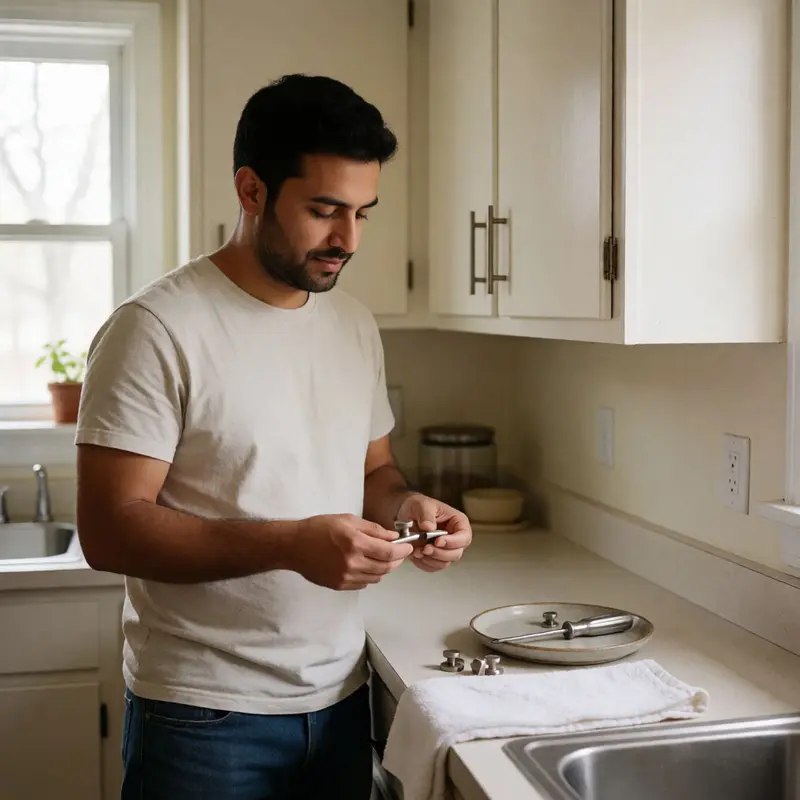
Kitchen cabinet hardware is the most-touched surface in many rentals, and builders know renters rarely get to choose it, so they spec the cheapest option: thin stamped pulls that wobble after six months and builder-grade knobs the color of old nickels. Swapping them out is one of the few renter friendly upgrades that costs under $50 for a full kitchen set and takes an afternoon with a single screwdriver.
Start with one existing pull or knob. Take it to a hardware store and match the hole spacing before you buy anything. Most standard pulls use a 3-inch or 5-inch center-to-center measurement, and when you find hardware that matches exactly, you’re screwing into holes that already exist, with no drilling, no patching, and no conversation with your landlord required. Drop the original hardware into a labeled zip-lock bag and tape it inside a cabinet. That bag is your exit strategy at move-out.
This swap earns its place in the details you actually notice every day. Matte black pulls on white cabinets, brushed brass on dark wood, ceramic knobs on a bathroom vanity: each costs about what you’d spend on two takeout lunches but changes how a room reads every single morning. This Old House frames hardware as a high-use item worth investing in for exactly that reason, and if you’re handling your pulls thirty or forty times a day, the feel of a solid piece versus a flimsy one registers immediately and keeps registering.
Hardware alone can’t rescue cabinetry that’s peeling, warped, or structurally tired. When the cabinets themselves are the problem, this swap polishes the surface without fixing what’s underneath. In most rentals, though, the boxes are structurally fine and simply stylistically dated, which is exactly what a hardware swap solves.
At move-out, put the originals back on, collect your deposit, and leave the next tenant with plain nickel pulls all over again.
5) Curtain upgrades: Layered privacy and measurable heat savings
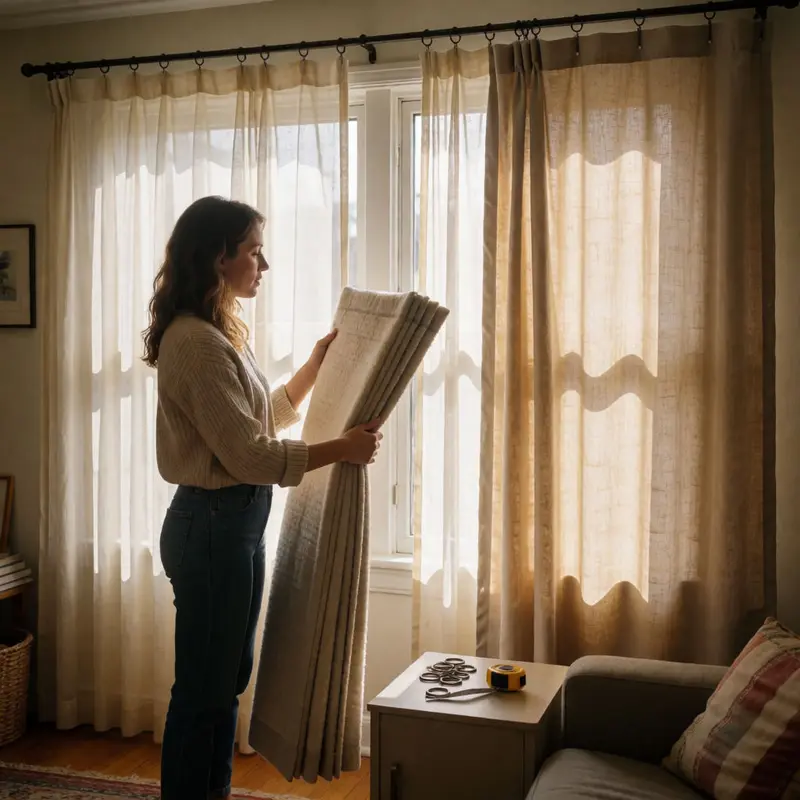
Most rental windows come with the same vinyl blinds: slightly grimy, slightly bent, doing the bare minimum. Replacing them entirely usually isn’t an option, but working around them is, and the payoff matters more than you’d expect.
Start with privacy, because that’s usually what drives the decision. Top-down/bottom-up shades let you lower the covering from the top to bring in daylight while keeping the lower portion closed against a street or a close neighbor. That in-between position is genuinely hard to get any other way. Adhesive privacy film on the lower pane is a cheaper companion move, and it pairs naturally with semi-sheer curtains hung above for a layered, warmer feel.
Layering is where renter friendly upgrades really earn their keep. Cellular shades, available in single-, double-, or triple-honeycomb configurations, trap air between the window and the room and measurably reduce heat loss; the more layers, the better the insulation, though the price climbs with each added cell. If your lease allows the hardware, pairing an inside-mounted cellular shade with outside-mounted drapes squeezes out more efficiency than either treatment does alone, which helps when a drafty window is pushing up your heating bill. Single-cell shades are the affordable entry point, but they’ll need a blackout liner if light control matters as much as temperature.
Curtains do another job that’s easy to underestimate: they change the perceived scale of a room. Hang them wall-to-wall and floor-to-ceiling instead of directly framing the window, and the room takes on a cozy, almost hotel-like effect while ceilings read taller than they are. A fuller look comes from buying curtain panels wider than your window span, so there’s enough fabric to gather softly instead of hanging flat.
The best part is that all of this comes down with you when you leave. The original blinds go back up, the adhesive film peels off, and the room resets to its baseline beige. Until then, your windows won’t just function better. They’ll feel like yours.
Final thoughts
Peel-and-stick surfaces, warmer bulbs, swapped hardware, and better window layers all point to the same truth: the strongest rental changes are the ones that improve how a place behaves, not just how it looks. When a room holds heat better, feels calmer at night, gives you real privacy, or simply works more smoothly under your hand, it starts to support your life instead of interrupting it.
That’s why renter-friendly upgrades have staying power beyond decor trends. They act like a temporary operating system for a borrowed space, changing the daily experience without pretending the lease disappeared. You still have limits. You also have more control than most rentals first suggest, and sometimes that’s enough to make an apartment finally feel settled.
Further reading
Leave a comment