















No products in the cart.

Shop this story
Walking pad vs premium standing desk: Which setup avoids regret in 2027?
by Anabel Figueroa
Remote work typing can feel clean and low effort, right up until your body starts keeping a tally. The walking pad vs standing desk decision usually shows up at that moment, when sore hips, tight shoulders, or a fading afternoon brain fog stop feeling like “normal.” You’re trying to work, not train for a marathon.
The hard part is that both options can look sensible and still turn into regret. A walking pad asks your focus to share space with steady motion, and it brings noise, upkeep, and real placement constraints into a home office. A premium standing desk feels simpler, but it only pays off if you actually change positions often enough to matter. By 2027, the wrong pick won’t just be wasted money, it’ll be another habit you couldn’t make stick.
Ergonomic impact: Posture shifts vs constant motion
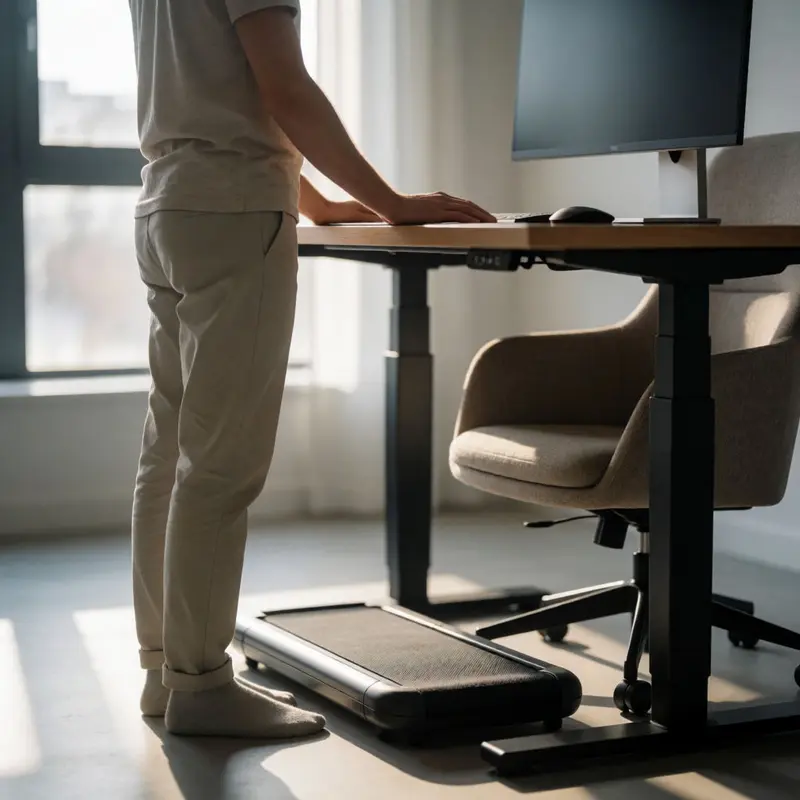
Remote work typists spend most of their professional lives in a single seated position, and the accumulated postural cost of that setup is the starting point for every serious conversation about walking pads and standing desks. These two setups address the sedentary problem in different ways, and choosing the right fit for a given workday means looking at what each one does to the body over hours of use.
A sit-stand desk intervenes by making transitions frictionless. The clinical rationale behind this design is that sustained sedentary time correlates with adverse cardiometabolic outcomes, and a height-adjustable surface helps shrink that sedentary block by letting someone shift postures without interrupting their workflow. The body gets a change of load, and the work continues unbroken. Memory presets on better desks lower the switching friction further, so a typist can cycle between sitting, standing, and even a third walking height without stopping to recalibrate.
A walking pad takes a different approach: it adds movement. Most under-desk pads are designed for slow, steady walking, typically around 1–2 mph, which is slow enough that the body handles the motion almost automatically. UPLIFT Desk’s ergonomic guidance identifies the conditions that make this work: desk height coordinated with the pad’s height to keep shoulders relaxed, the monitor at true eye level to eliminate downward neck flexion, and a keyboard tray (ideally with a negative tilt) to keep the wrists neutral. That coordination gets harder when the work itself is cognitively demanding, since research on dual-task walking shows that heavier cognitive load measurably degrades gait quality. A typist composing a routine email handles the movement easily; one restructuring a complex argument may find their steps growing uneven before they notice.
In the walking pad vs standing desk decision, the real split is whether your day needs more posture changes or more low-grade motion, and whether your tasks can tolerate movement without costing you attention.
Economic considerations: Upfront price versus years of upkeep
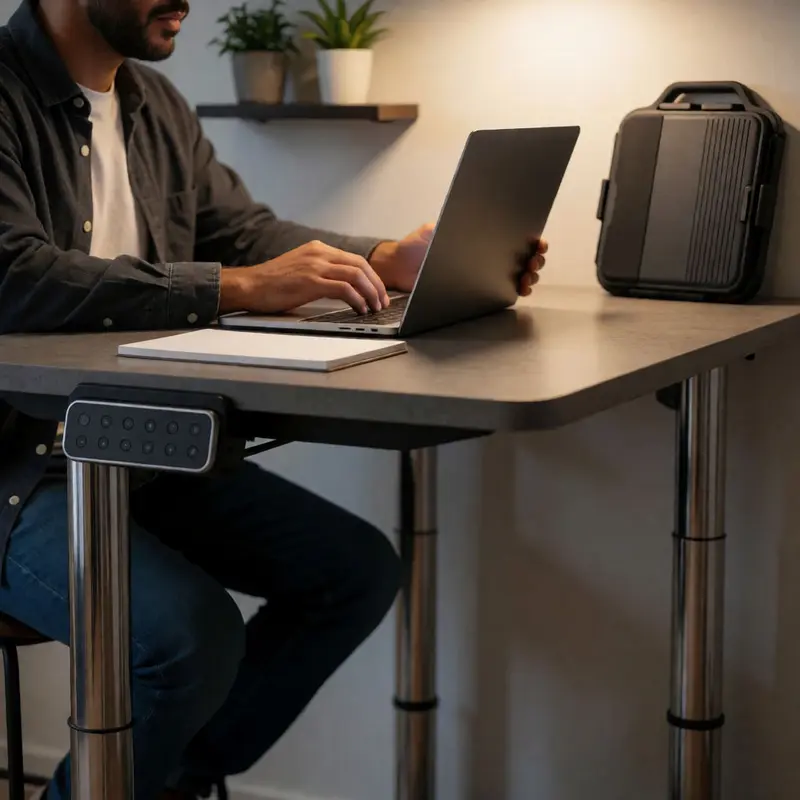
The sticker prices on walking pads run from roughly $499 to $699 for mid-range foldable models, which can make them feel, at first glance, like the obvious budget pick in the walking pad vs standing desk comparison. That framing holds up until you start listing what the sticker price leaves out.
A walking pad arrives as a 60-pound unit that needs a level surface, ideally a dedicated floor mat to cut noise transmission, and, if your home office shares a circuit with other high-draw appliances, potentially its own electrical circuit. None of these additions are expensive in isolation, but together they turn what felt like a clean $499 purchase into a small project with a real total. Add periodic lubrication, which the belt requires every few months under normal use and more frequently under daily heavy sessions, and you’ve got an ongoing maintenance obligation that costs both supplies and attention. Do it wrong and you can actually degrade the motor instead of protecting it.
Premium standing desks come with a different cost structure. UPLIFT, for instance, backs its desk frames with a 15-year warranty, and its converter line ships with a 10-year warranty, free shipping, and free returns. You’ll spend more upfront than you would on a walking pad, but the warranty absorbs what would otherwise be repair-or-replace decisions spread across a decade and a half.
Lifespan is where these two options diverge most sharply. A quality walking pad, properly maintained, can run reliably for seven to twelve years; a cheaper unit may degrade within a few. The practical rule of thumb for either treadmill-style equipment is to weigh replacement against repair when repair costs approach half the price of a comparable new model. A standing desk with a 15-year warranty sidesteps that calculation almost entirely.
So the real budgeting question is simple: are you buying a machine you’ll keep tending, or a desk you’ll mostly forget about once it’s assembled? Both can make sense for remote work typists, but only if you price in the work, the interruptions, and the longevity you’re actually signing up for.
User experience: Adapting to motion versus effortless flexibility
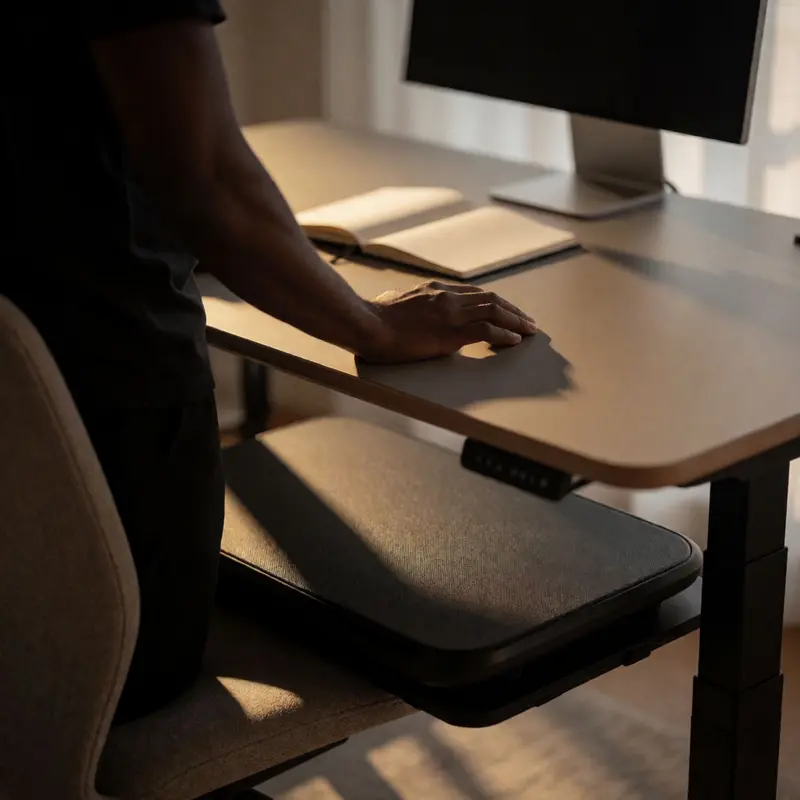
Walking pads operate in a surprisingly tight speed window for actual work: most users settle somewhere between 1.0 and 2.5 mph, slow enough to type an email or follow a video call without losing their place mid-sentence. That constraint is the whole design logic. The belt is shorter, there are no handrails, and the motor is tuned for sustained low-speed movement, so the experience stays stable at a steady pace. That mobility comes with a narrower operating window than marketing materials tend to admit, and Consumer Reports has flagged stability concerns on lower-end models that make build quality a genuine variable.
A standing desk swaps that kind of movement for flexibility. You can sit, stand, shift posture, take a call leaning forward, then drop the surface for a focused writing session, all without changing your physical relationship to the screen in front of you. The usability attributes that separate a premium model from a cheaper one, quiet motor systems, smooth height transitions, solid weight capacity, matter because interruption-free adjustment is what makes the habit stick. A desk that whines and wobbles on the way up tends to stay at one height.
The sharpest difference between the two setups shows itself over a week of mixed work. Most walking-pad users report needing roughly one to two weeks before slow-pace movement starts to feel natural alongside cognitively demanding tasks. Standing desks don’t require a comparable adaptation period, but the research on sit-stand desks is honest about their limits: alternating between sitting and standing produces better outcomes than prolonged standing, which means the desk alone reframes the sedentary problem instead of solving it.
So where does that leave you in the walking pad vs standing desk decision? The practical answer is that each device earns its keep in a different constraint: the walking pad is about steps inside a narrow speed band, and the height-adjustable desk is about postural range with minimal friction. If your workday is mostly typing, the best pick is the one that fits your bottleneck: space and pace for the pad, or smooth, quiet adjustability for the desk. And if you can support both with the space, the budget, and the workflow flexibility, the pairing closes the gaps each one leaves open.
Future outlook: Movement rhythms become health infrastructure
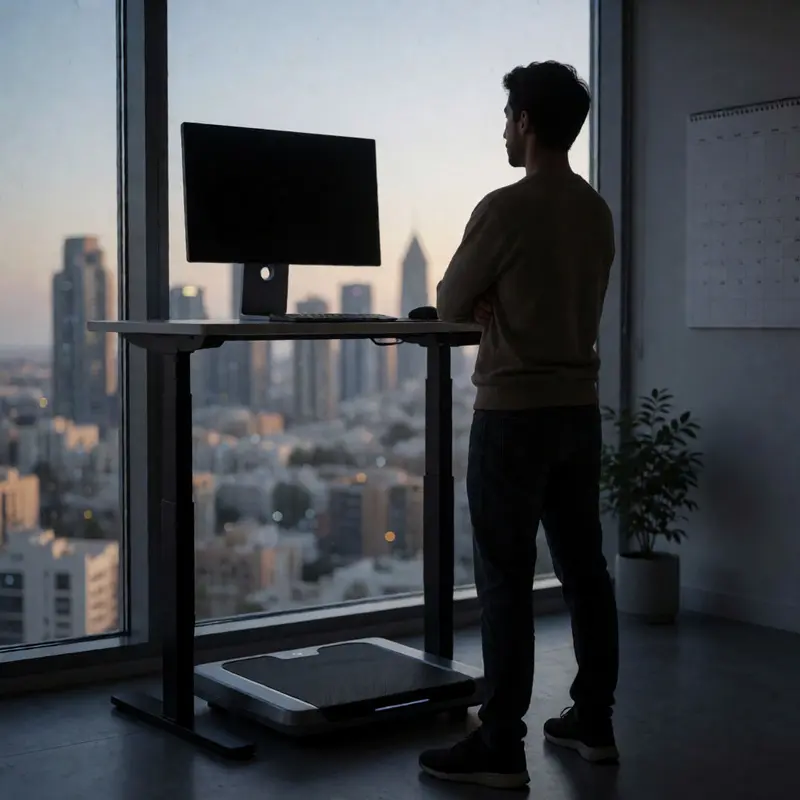
Researchers are now studying whether sit-stand workstations can improve insulin resistance and cardiometabolic markers in people with elevated diabetes risk. That tells you something significant about where this space is heading. Ergonomic accessories are quietly being reclassified as preventive health tools, and the walking pad vs standing desk question sits squarely in the middle of that shift.
The science behind both options points to the same underlying principle: movement variability drives the benefit. Standing desk research shows gains in perceived concentration and reduced stress, and those gains come from posture change and cycling through positions instead of locking into one for hours. The same logic governs the walking pad case. Its productive range tops out at a slow walking pace, which is genuinely all most typing work can accommodate, and that narrow band is exactly where light movement’s metabolic benefits start to accumulate.
Research has also clarified that static standing carries its own costs. Prolonged time on your feet without variation is linked to lower-limb pain and circulatory problems, so a standing desk earns its reputation when you treat it as a cycling tool. The 20-8-2 framework, popularized by standing desk brands, captures this honestly: sitting, standing, and moving all belong in the rotation, and the desk or pad you own is only as useful as the habit it enables.
By 2027, the workspace won’t look radically different from today’s, but the standard of care around it is rising. Employers, insurers, and individuals are taking sedentary behavior seriously enough that the conversation has moved from productivity accessories to health infrastructure. The real separator won’t be the spec sheet. It’ll be whether your setup makes it easy to keep a steady rhythm, consistently, across a full workday.
Final thoughts
The regret-proof setup in 2027 won’t be the one with the flashiest specs. It’ll be the one that quietly fits how you work on your most demanding days, when you’re deep in writing and don’t have extra attention to spend on your equipment. Comfort gains that depend on constant fiddling tend to fade.
Think in terms of rhythm. When your desk and floor plan make it easy to cycle between sitting, standing, and a bit of movement, you get the kind of day-to-day variability that health research keeps rewarding. That’s the real answer behind walking pad vs standing desk: pick the tool that your space, workload, and tolerance for maintenance will support consistently. Consistency is what you’ll feel, months later.
Further reading


Leave a comment