
















No products in the cart.

Shop this story
Beat the morning slump: Worker blueprint for speed
by Elizabeth H
Most ambitious knowledge workers do not lose their speed because they lack talent. They stall because their mornings feel like a slow boot sequence, with groggy thinking, scattered priorities, and a body that has not caught up to the pressure of the day. When your sharpest hours get swallowed by sluggish starts, every meeting, email, and decision costs more effort than it should. A 10 minute morning reset can become the difference between dragging yourself into the workday and stepping into it already switched on.
The way you manage the first minutes after waking quietly writes the story of your performance blocks, your ability to focus under pressure, and your capacity to sustain energy without constant stimulants. Treat those minutes as a compact, repeatable system rather than a rushed scramble for coffee and notifications, and you turn physiology into a competitive advantage. This blueprint walks through how to prime sleep so mornings run clean, activate your body and breath for fast cognitive gains, fuel your brain with simple hydration and micro-movement, and then direct that newfound clarity toward deliberate priorities. The result is a practical sequence you can run almost anywhere to convert a sluggish start into fast, focused execution.
Preparation: Lock in sleep so mornings run fast

You cannot outrun a brutal morning if you quietly wreck the night before. Your 9 a.m. sharpness is basically pre-written by what your brain does between lights out and your alarm.
Modern sleep research lets scientists watch the sleeping brain in wild, high-definition detail. With miniaturized multi-photon microscopes, they can track high-resolution activity from specific cell types while animals move naturally through their sleep-wake cycles. In mouse models, those tools have confirmed what ambitious workers already suspect. Sleep is not passive. It is your nightly systems upgrade.
While you sleep, your brain synchronizes its activity and replays key pieces of your day. That internal replay helps memories consolidate, and it helps your brain pull patterns out of yesterday’s chaos of inbox threads, meetings, and stubborn problems. When those natural cycles run clean and uninterrupted, your brain actually finishes its overnight work. You wake up clearer, faster, and far more alert.
When those cycles get chopped up, you pay for it in the morning.
Protocols that protect uninterrupted natural cycles consistently support better wakefulness, better focus, and more stable energy. For you, that translates into treating the 60 to 90 minutes before bed with the same intention you bring to a product launch or critical client call. The objective is simple. Make it ridiculously easy for your brain to slide into deep, continuous sleep.
A short checklist keeps your evenings from getting hijacked:
- Choose a specific wind-down window and guard it like a non-negotiable meeting with your future self. That predictable timing helps your brain shift into a sleep-ready mode instead of staying locked in work-brain.
- Add 1 or 2 calming activities, such as reading, stretching, or quiet reflection. These lower physiological arousal and keep late-night anxiety or rumination from taking over.
- Remove stimulating inputs in that window, especially work debate, message ping-pong, and intense media. That simple filter cuts down on triggers that cause sleep fragmentation and middle-of-the-night wakeups.
Those small choices are not trivial. Calming routines help you avoid repeated awakenings, and preventing fragmentation reduces the heavy, foggy sleepiness that drags down your first hours at work.
Your goal is not perfect sleep. Your goal is a sleep-wake cycle that’s predictable enough for your brain to handle its nightly maintenance so you can execute at speed the next day. Once that foundation is locked in, resources on AI empowered morning routines and the dynamic stretching that follows can finally work with your nervous system, instead of fighting against a tired one.
Activation: Dynamic stretching to switch your brain on

Your sleep just handled the deep repair work. Now it’s time to bring your system fully online with movement that wakes up your body and your brain.
If your mornings start with a screen, a chair, and a foggy head, your nervous system is still idling low. You’re awake, but you’re not really switched on yet. Dynamic stretching is the fastest way to jumpstart circulation, reduce stiffness, and signal to your brain that it’s time to perform, making dynamic stretching for deskworkers one of the most leveraged habits you can build into your day. Instead of holding static poses, you use controlled, active movements that steadily increase your range of motion and blood flow.
Think of a 10 minute morning reset as a simple circulation circuit. You’re not training for a marathon. You’re just turning the lights on in your muscles and cognition so you can work at speed and think clearly.
Start with the big joints that get jammed by desk life:
- Leg circles and leg swings: Stand behind a chair for balance. Gently swing each leg forward and back, then make small circles. This wakes up your hips and lower back, and it starts to reduce stiffness that can quietly turn into pain in a few weeks if you ignore it.
- Arm swings and shoulder rotations: Sweep your arms across your chest, then open them wide. Next, make easy circles with your shoulders. This boosts blood flow around your shoulders and upper back and supports sharper focus, because you are not burning energy just fighting tension.
- Neck rolls: Slowly trace half circles with your chin from one shoulder to the other. Keep it smooth, not forced. This targets the tension you collect from hours of screen time and makes basic sitting and reading feel more comfortable.
- Overhead triceps reaches and lateral leans: Reach one arm overhead, bend at the elbow, then lean gently to the side. Switch sides. This lengthens the sides of your torso and helps your spine feel prepared for another day of sitting and typing.
Taken together, this desk friendly sequence focuses on exactly where knowledge work tightens you up. Hips, lower back, shoulders, neck, and wrists are common sources of pain and long term musculoskeletal risk. When you move them early and often, you lower the chance that simple sitting turns into injury, chronic discomfort, or absenteeism.
Here is the productivity logic. When blood flow improves, your brain gets more oxygen and nutrients. That supports faster cognitive processing, cleaner thinking, and a sharper sense of focus in your first deep work block.
Dynamic stretching is not just a morning trick. If you run short rounds every 30 to 60 minutes, you interrupt sedentary fatigue before it builds into that late morning crash. Even sixty seconds of leg circles or shoulder rotations can reset your posture, clear some mental fog, and pull your attention back to the task that matters.
With daily 5 to 10 minute dynamic sessions, you typically feel less lower back and shoulder pain within 2 to 3 weeks. Over 4 to 6 weeks, your flexibility improves, so the same workday positions demand less from your body. The result is a quiet confidence that your body can support the pace and ambition of your work without constantly complaining.
As your muscles and circulation shift from idle to engaged, your mind is ready for its own activation. The next layer is simple, deliberate breathing that clears mental fog and lines up your focus for the day ahead. Ready to stack that on top of your movement reset?
Reset: Deep breathing to clear the morning fog
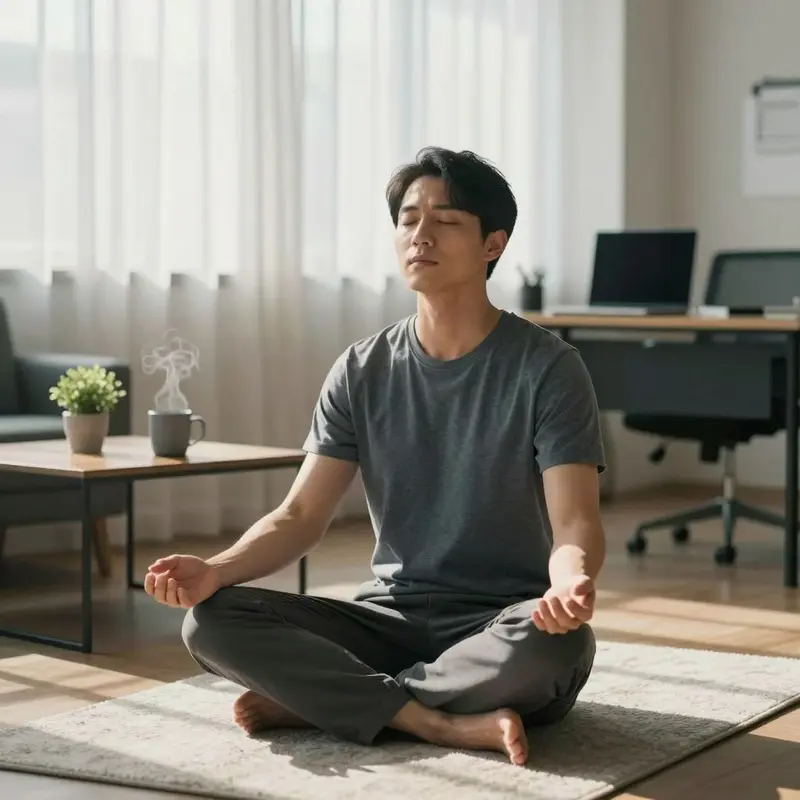
Your body is humming at a low idle right now. That means your mind is in a perfect spot for a fast mental reset.
Deep breathing is your simplest tool for cutting through that morning fog. You do not need an app, a mat, or the right playlist. You just need about two minutes of attention and your own lungs. When you use it consistently, it becomes a core protocol for beating the morning slump and restoring that calm, steady focus before the day grabs you and starts making demands.
Think of this as your 10 minute morning reset for your brain. Movement wakes the body. Breathing organizes the mind. You are shifting from scattered and reactive to clear, deliberate, and in charge.
Start with a single, reliable pattern. The 4-7-8 breathing technique is quick and silent and needs no equipment, which makes it ideal for ambitious knowledge workers who do not want a complex ritual.
- Inhale through your nose for a count of 4. Let your belly rise and soften.
- Hold that breath gently for a count of 7. Notice any tension without trying to fix it yet.
- Exhale through your mouth for a count of 8. Let your shoulders drop and your jaw unclench.
Repeat this cycle 4 times. Treat the counts as a loose framework, not an exam you are trying to pass. If 7 feels long at first, stay curious instead of annoyed with yourself. The real point is controlled, deliberate breathing, not perfect timing or flawless form.
As your breath slows, your mind gets a brief, clear task to focus on. That simple, structured focus interrupts your usual thought loops and can stop stress from snowballing into a full anxiety cycle. Over time, this builds your ability to handle pressure with more clarity, so you are not waiting for problems to blow up into crises and then scrambling for reactive fixes.
You can stack even more benefits by linking this breathing pattern with your sleep hygiene. Run a few rounds of 4-7-8 as a pre-bed cue and then repeat a few cycles right after you wake up. This pairing teaches your system that controlled breathing signals safety. That sense of safety improves emotional regulation and sharpens your morning focus.
Deep breathing also trains your awareness of your emotions. As you breathe, quietly name what you feel in a single word. For example, “rushed,” “uncertain,” or “excited.” That simple label lowers emotional noise and builds resilience, because you are responding to a clearly named state instead of reacting to a vague, heavy feeling in the background.
To amplify the effect, pair your breathing with other light mindfulness practices such as a one-line journal entry or a brief body scan from head to toe. Together, these practices, including meditation and breathing, support emotional wellbeing and cognitive performance, so you are not relying only on stimulants every time your energy dips or your focus scatters.
Interestingly, research on newborn respiratory function shows how fundamental controlled breaths are for handling stress. The same principle still applies to you as an adult. When your breathing is steady and intentional, your system is better equipped to carry mental strain without tipping into overload.
In practice, your protocol stays simple. Move your body first, even for a couple of minutes, then run a few cycles of 4-7-8 breathing to stabilize your focus and mood. Once your breath has cleared some space in your head, you are ready to support that new clarity with the next layer of your reset: targeted hydration that boosts alertness through water and movement.
Hydration: Lock in morning focus with water and micro-movement

Your breath just cut through some of that mental fog. Now it is time to give your brain the raw material it needs to stay sharp. That starts with water. Then very small, very intentional movement.
Overnight, you quietly lose fluids through breathing and sweating, even if you do not wake up feeling thirsty. That low-level dehydration can dull your focus and make your first work block feel heavier than it needs to be. Morning water intake restores that fluid balance, which supports attention, reaction time, and clearer thinking. You are not chasing some vague wellness trend. You are simply refilling a resource your brain relies on to work fast.
Treat this like a mini protocol inside your 10 minute morning reset, not a loose intention to “drink more water.” As soon as you finish your breathing, drink water before coffee, news, or email. Aim for a steady, comfortable amount that truly feels like a refill instead of a few distracted sips between notifications, and if you like having evidence behind your habits, you can even skim this research-backed hydration and alertness link for extra motivation. Stay mentally present for those moments so your nervous system starts to associate hydration with the feeling of waking up.
Once the glass is empty, it is time to move so you lock in the effect. Short bouts of movement right after hydrating can boost cerebral blood flow, which can enhance alertness for roughly 1 to 2 hours. You do not need a workout. You need circulation.
A simple sequence could look like this:
- 30 to 60 seconds of marching in place or brisk walking around your home. Focus on a confident arm swing and upright posture.
- 30 to 60 seconds of gentle squats or sit-to-stands from a chair. Move slowly, feel your feet, and control the lowering.
- 30 to 60 seconds of shoulder circles and neck rolls. Stay out of pain and focus on smooth, easy range of motion.
By the end of this short protocol, your body is sending much clearer signals that it is time to be awake, not groggy. Pairing hydration and light movement like this can noticeably improve productivity. In one simple two week log, people reported a 25% reduction in their subjective energy slump.
Once your body is on your side, your sharpened energy is no longer random. You are ready to decide exactly where it goes next, which is where clear daily priorities come in.
Intention setting: Turn your sharpest hours into focused execution

Your physiology is finally working for you. That means your next smart move is choosing what actually matters today, instead of letting other people’s urgency make that choice for you.
Intention setting is not a cute journal prompt. It’s a performance tool. When you decide, on purpose, what gets your best energy, you turn that sharper morning state into focused execution instead of scattered busyness that feels productive but changes nothing.
To pull that off, you need a clear mind first. Not later. Practices drawn from Gary Brecka’s morning protocol, like breathwork, grounding, and mobility, help cut through mental fog and give you the calm focus that real planning needs. Morning sunlight and light mobility also help reset your circadian rhythm, and pairing those with mindfulness for daily focus supports more stable energy and makes it easier to follow through on your priorities instead of chasing coffee, notifications, and stimulation all day.
Think of your 10 minute morning reset as a daily board meeting with yourself. For those ten minutes, your only job is to decide where your limited attention will go and what absolutely does not get to win.
Use a simple three part structure:
- State your intention in one sentence. For example, “Today I prioritize deep work on the strategy deck.” This becomes your internal headline for the day, the sentence you can return to when everything starts competing for your focus.
- Choose your top three priorities. Make them specific, high leverage, and realistic. These are the items that earn your best cognitive hours, not the leftover scraps of your attention once your inbox is empty.
- Define one non negotiable habit. Tie it directly to your energy and focus, such as a walk in sunlight, a short breathwork block, or a mobility break between meetings. This is the habit you protect, even on busy days.
This small ritual actually mirrors what’s happening inside leading organizations that use AI to redesign how they work. They’re shifting roughly 70% of their effort toward processes and people, not just tasks. By 2025, most enterprises will even measure ROI through upskilling and cultural improvements, not only output and volume. Why does that matter for you?
Because you can apply the same logic at a personal level. Instead of endlessly experimenting with random productivity hacks, you move to executing a small, consistent set of reliable daily priorities. You become the person who optimizes their own process and capability, not just their to do list.
Over time, this kind of morning ritual trains a quiet confidence. You start each day already knowing what matters, why it matters, and how your body and routines are set up to support it. When your energy dips or distractions spike, you can come back to that single sentence intention and your top three priorities. Then you choose focus instead of drift, and progress instead of just more motion.
Final thoughts
When you zoom out, the pattern is simple. Nights that protect real recovery set up mornings where movement, breathing, and hydration flip your brain from idle to engaged, and clear intentions direct that power toward work that actually matters. Your biology, attention, and priorities stop working at cross purposes; instead, they reinforce each other so that focus feels less like a heroic effort and more like the natural outcome of a well designed start. The morning slump does not disappear by accident, it recedes because you have built a reliable chain of small, physical and mental cues that pull you into alert, purposeful action.
The deeper payoff is not just a smoother first hour, it is a new baseline for how you engage with your ambition. A consistent 10 minute morning reset teaches your brain and body that clarity and speed are trainable, not mysterious gifts that appear on rare “good days.” Each repetition strengthens the signal that your time and attention have a clear owner. The question is no longer whether you can be fast and focused, but how quickly you are willing to turn this compact protocol into a non negotiable part of your workday.
Ready to prioritize your well-being with expert-backed wellness strategies? Contact OnInitiative.com ([email protected]) today and let our team help you build a healthier, more balanced lifestyle, inside and out!
About us
OnInitiative.com is an innovative marketplace that helps e-commerce businesses boost productivity and community growth through advanced automation tools. By connecting companies with tailored wellness and productivity solutions, OnInitiative.com empowers organizations to enhance employee health, reduce burnout, and foster a more engaged digital workforce.
Further reading


Leave a comment