
















No products in the cart.

Shop this story
Why a walk somewhere green resets your stress better than a full day on the couch
by Elizabeth H
By the time Friday night hits, the couch can feel like a reward you earned. But if you’ve ever spent a full day there and still felt wired, foggy, or oddly un-rested, you’ve already run into the limit of passive recovery. The benefits of walking in nature matter here because stress doesn’t only drain your body; it also keeps your attention system idling hot long after work ends.
A quiet walk somewhere green can feel more effective than a day of doing almost nothing because it gives your attention system a clear place to cool down. It offers mental relief from screens, walls, and low-grade indoor static, even when your body stays mostly at rest.
Audit stress recovery needs, not just physical rest

Picture the end of a week that ground you down. You close the laptop, migrate to the couch, and spend most of Saturday horizontal, phone in hand, shows cycling on in the background, body finally still. By Sunday evening you expect to feel restored. Instead, you feel vaguely hollow, like something in you was running all weekend and never quite stopped.
That gap has a structural explanation. Psychologists studying recovery have mapped rest into distinct categories, physical, mental, sensory, emotional, and several more, and the categories don’t automatically fill each other in. Lying still addresses physical depletion, but the grinding cognitive load of a hard week deploys a different drain entirely: sustained directed attention, the kind that forces you to filter distractions and hold a single thread of thought against competing ones. Physical stillness doesn’t reach that system. Something else does.
Nature exposure, even in short doses, appears to address exactly that system. A systematic review of minimum-dose studies found that as little as 10 to 20 minutes sitting or walking in a natural setting produced significant positive changes in psychological and physiological markers of well-being compared with the same duration in urban environments. The mechanism isn’t mysterious: natural settings make low-level demands on attention rather than high-level ones. Your eyes track movement in leaves, ambient sound arrives without urgency, and the brain’s filtering machinery gets something close to a genuine pause. An fMRI study measuring this directly found that a one-hour nature walk reduced activity in the amygdala, the region most associated with threat appraisal and stress reactivity, relative to an urban walk over the same duration.
A separate neuroscience study measured frontal midline theta activity, a marker of cognitive effort, and found it lower after a nature walk than after an urban one, consistent with real attentional relief rather than the appearance of it. That physiological signal doesn’t guarantee recovery from every dimension of stress (one well-designed experimental study found mood improved after a nature walk but cognitive performance did not shift measurably), and cortisol-based evidence across the broader literature is genuinely mixed. What the evidence does establish, clearly enough to act on, is a distinction worth internalizing: some kinds of depletion require more than stillness, and walking somewhere green, even briefly, works through mechanisms that a day on the couch simply doesn’t engage.
Knowing which mechanism you’re missing is the first step toward actually fixing it.
Quick wins: Aim for 20–30 minutes nearby
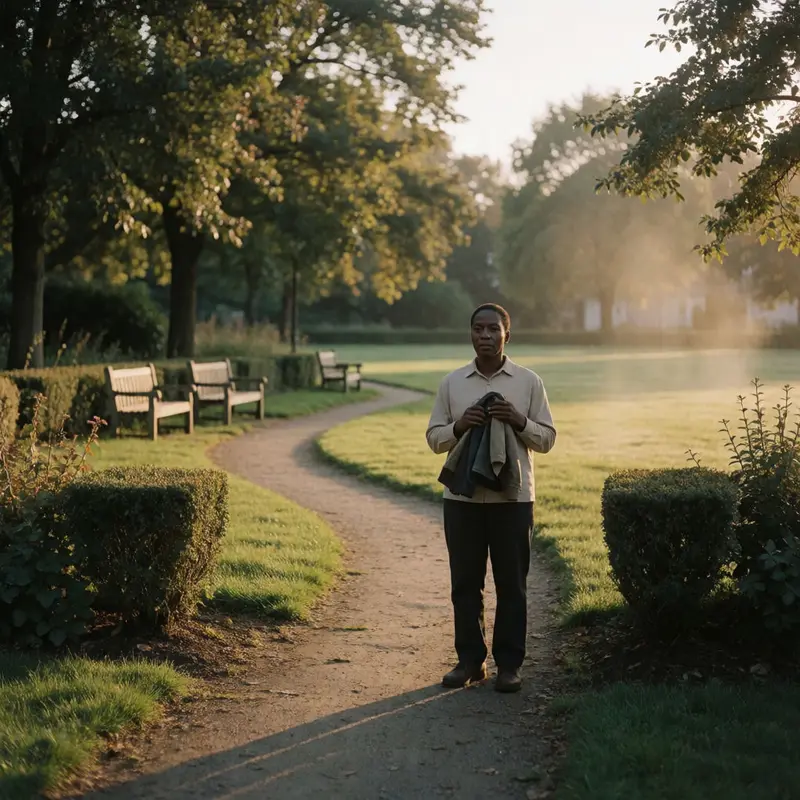
Research shows that spending twenty to thirty minutes moving outdoors yields the steepest measurable drop in cortisol, with gains flattening noticeably once that window closes. Treat that single data point as a design constraint rather than a general observation, because it offers an immediately practical takeaway: a half-hour is enough, and the habit works on that cadence.
Proximity and repetition make it work. A CDC review found that green space benefits extend even to residential streets with modest tree cover, which matters because distance is the most common reason a good intention collapses. When the nearest option is a ten-minute drive to a forest preserve, the activation cost of going compounds until the habit disappears.
A park two blocks away with a line of mature trees and a strip of grass outperforms a pristine nature reserve you visit twice a year because you’ll actually go. One well-conducted experimental study did show that a single 50-minute forest walk produced the most consistent psychological improvements even when participants had to drive to reach it, so a more immersive setting carries real value when you can manage it. On ordinary weeks, the nearest green route you’ll actually use is the strategically superior choice.
The repeatable walking window matters for a similar reason. The stress-relief effect of a walk in a natural environment doesn’t vary much by time of day, which removes one of the easier excuses for skipping it. Morning, lunch hour, early evening: the physiological response tracks the exposure, not the clock. What that means practically is that you can anchor the walk to whatever moment in your day has the least resistance: just after you close the laptop, just before you start cooking, first thing before the morning’s demands stack up. The specific timing is less important than its consistency across days.
The evidence on effect sizes is genuinely contested, some green-exercise literature likely overstates benefits, and short urban walks do produce some measurable reduction in negative affect on their own. But the pattern across studies points clearly toward one thing: the benefits of walking in nature accumulate with regular exposure in a way that irregular, longer outings don’t replicate. Small per-dose effects, repeated across weeks, add up to something the research on single sessions can’t fully capture. The practical architecture, then, is simple: identify the greenest route within comfortable reach, assign it a time slot that has the fewest competitors in your schedule, and treat that pairing as fixed rather than optional.
Quick wins: Stack duration, terrain, and attention
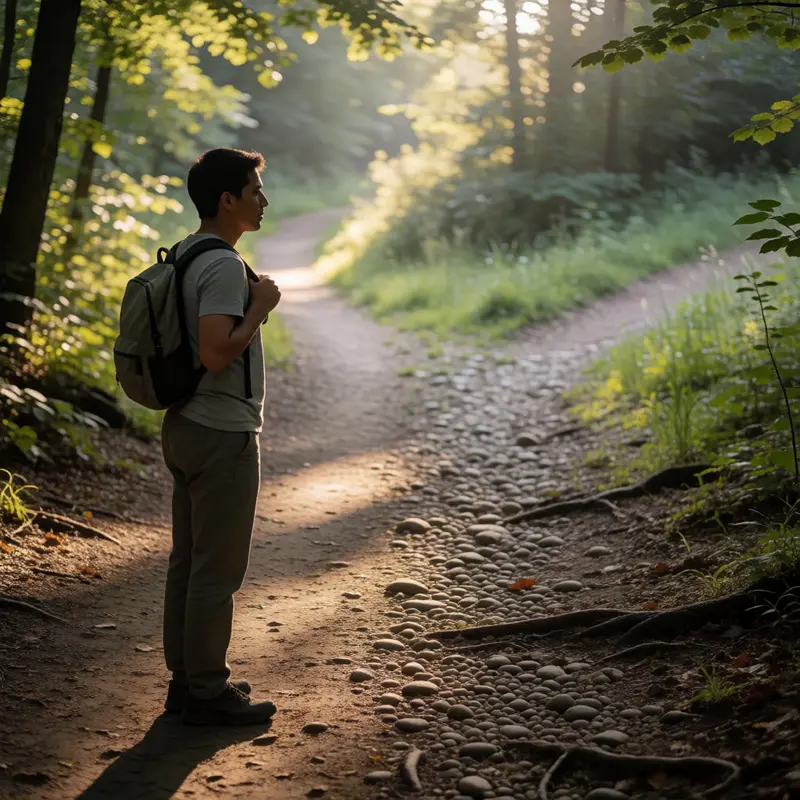
Route selection does more measurable work than most people expect, and the research on which variables actually move the needle is specific enough to act on. Duration, terrain, and attentional posture each influence the stress response in ways that are largely independent of each other, which means you can stack them deliberately.
Duration is the variable with the clearest shape. Twenty minutes of walking or sitting in a natural-feeling space is already associated with a significant cortisol reduction; lengthening the walk into the next ten minutes tends to produce the steepest drop, after which additional time adds benefits more slowly. Sessions running longer than sixty minutes show diminishing returns for mental health outcomes compared with those under that threshold, so the case for a very long outing rests more on enjoyment than on restorative efficiency. That said, these averages carry real individual variability, and for someone dealing with severe stress-related illness rather than ordinary accumulated tension, a structured walk is unlikely to function as anything close to a complete intervention.
What happens during the walk matters alongside how long it lasts. A nature-walking protocol developed for clinical mental health settings includes brief attentional routines, roughly three to ten minutes, such as focused listening to birdsong, conscious breathing, and deliberately directing attention toward water, plants, or moving light. These aren’t meditative luxuries bolted onto the walk. They appear to support the attentional recovery that distinguishes a restorative walk from a distracted one. Passive attention to an interesting landscape does some of this work automatically, but deliberately anchoring that attention seems to sharpen the effect.
Route character amplifies all of it. Hiker data links time spent in biodiverse locations near water, and in places rated as visually pleasing, with larger cortisol decreases than equivalent time in less-varied terrain. The practical implication is concrete: if you have two roughly equal routes available, the one that passes a stream, a dense tree line, or any genuinely varied landscape is the stronger choice, even if the distance is identical. A randomized crossover study confirmed the same directional finding: a nature trail produced greater reductions in both cortisol and heart rate than an urban path walked for the same duration.
The benefits of walking in nature, then, aren’t uniformly distributed across whatever walk you happen to take. They concentrate in a specific window of time, in settings with genuine ecological variety, and in a quality of attention that you can structure rather than leave to chance.
Deep optimization: Choose high-naturalness, let soft fascination work
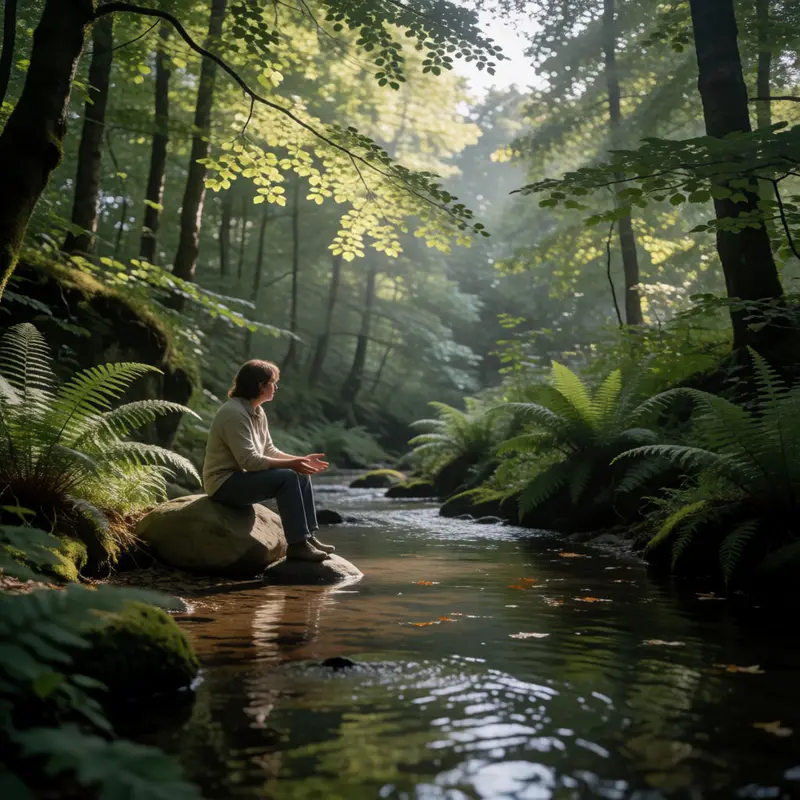
Two separate bodies of theory converge on the same design problem: how do you build a walk that does the most restoration possible, given a fixed stretch of time and a finite set of nearby routes? Attention Restoration Theory frames natural scenes as environments that engage involuntary attention. This is the kind that requires no effort and depletes no cognitive reserve, leaving the directed attention system to recover in the background. Stress Reduction Theory approaches the same environment from a different angle, treating its calming physiological effects as the primary mechanism. Running them together produces a more useful framework than either offers alone.
ART organizes the restorative properties of a natural setting into four conditions: being away, extent, compatibility, and soft fascination. Of these, soft fascination is the most actionable for route design. It describes the quality of a landscape that holds attention gently, birdsong, moving water, varied light through a canopy, without demanding interpretation or decision. Cortisol data from forest-versus-urban comparisons in environmental psychology and psychophysiology consistently show that forest environments produce meaningful reductions while urban environments produce almost none, which suggests that soft fascination is doing real physiological work and not just providing a pleasant backdrop. It is worth noting, though, that this recovery appears strongest for anxiety and fatigue specifically. The evidence in environmental psychology and psychophysiology thins out when the target outcome is something like persistent depression, which requires more than a well-chosen landscape.
The neural picture reinforces the route-design logic. A 40-minute nature walk has been shown to enhance executive control at a measurable neural level, and a one-hour walk in nature produced a detectable decrease in amygdala activity, the region most directly tied to threat-appraisal and acute stress reactivity. These aren’t marginal findings. They suggest that what looks like a simple walk is, at the right dose and in the right setting, producing changes in how the brain allocates and processes attention.
Translating this into route decisions means treating naturalness as a concrete variable. A path that passes a stream, moves through a tree line dense enough to create canopy closure, or traverses terrain with diverse plant and habitat features delivers more of what both theories identify as active ingredients than a manicured park path of identical length. The degree of naturalness shapes the outcome, routes differ in restorative yield not just in pleasantness.
The practical design principle that follows: choose the highest-naturalness route available within your time window, then let the landscape’s soft fascination do its work without filling the silence. Walks where the setting itself does the attentional lifting deliver the greatest benefits of walking in nature.
Verify and iterate: Benchmark cortisol, then tune your walks

A 21.3% per-hour drop in cortisol beyond normal daily decline is a precise enough signal that it deserves more than a one-time experience. Treated as a benchmark, it becomes something you can actually test against your own pattern, running a rough before-and-after on perceived tension, sleep quality, or mental chatter across a week of consistent nature walks, then adjusting the three variables that the evidence identifies as genuinely movable levers: duration, setting quality, and frequency.
Duration has a practical sweet spot that the research places at 20, 30 minutes. That window appears to capture the steepest part of the cortisol-reduction curve, with longer walks adding diminishing returns rather than proportionally greater benefit. If you’ve been defaulting to longer sessions on the assumption that more is always better, the data suggest the time might be more efficiently spent on an additional short walk later in the week. An umbrella review drawing on 20 separate systematic analyses found measurable psychological and physiological improvements from as little as 10 minutes in natural settings, which means frequency can function as a meaningful dial even when time is genuinely scarce.
Setting quality is the variable that tends to get treated as fixed when it shouldn’t be. Cortisol findings suggest that the drop in a forested environment can be roughly twice what an urban walk produces, sometimes urban walking produces almost nothing, and a 2025 meta-analysis found that city walking may actually exacerbate anxiety in some cases. The relevant distinction for iteration isn’t simply green versus grey; it’s the degree of ecological richness and visual complexity. Biodiverse landscapes with moving water, canopy variation, or genuine terrain irregularity produce stronger restorative responses than manicured parks of equivalent area. If a route you’ve been using feels like it’s stopped working, shifting toward higher-naturalness settings is the most evidence-supported adjustment available.
Tracking outcomes honestly also means holding one uncomfortable finding: for people carrying intense, ongoing stressors rather than ordinary daily load, additional nature time alone has been associated with higher long-term cortisol markers, not lower ones, suggesting the practice works best as a regular maintenance habit rather than a crisis-response intervention deployed only at peak overwhelm. The iteration logic that follows from this is straightforward: use perceived stress as a weekly signal, adjust one variable at a time so you can actually read what changed, and treat the benefits of walking in nature as a calibration problem rather than a fixed prescription.
What you’re building, across weeks of small adjustments, is a protocol tuned to your specific stress architecture, one that the aggregate evidence supports but that no single study could have prescribed for you.
Final thoughts
A walk under trees starts to look like a stress tool with settings, not a vague wellness tip. Once you see that, the real advantage isn’t intensity or virtue; it’s precision. A nearby route, a workable time window, and a setting that can hold your attention gently can do more restorative work than a heroic plan you’ll rarely repeat.
That shifts the benefits of walking in nature into a practical question of fit. When your stress follows a pattern, your walk can follow one too, tuned by duration, frequency, and how much the place itself carries the mental load. The useful goal is a version of recovery you’ll actually use, before stress hardens into your normal setting.
Further reading


Leave a comment