









No products in the cart.

Shop this story
Why I ditched Lululemon’s Get Low leggings: A retrograde review
by Anabel Figueroa
Athleisure founders are building products in a market where customers expect luxury-level comfort, technical performance, and frictionless buying journeys, all at once. The gap between what a legging promises on a product page and how it behaves after months of real wear has never been more visible, or more expensive. When a flagship brand misjudges fabric choices, fit expectations, or experience design, the fallout shows up in reviews, returns, and hard questions about trust. Read any detailed lululemon Get Low leggings review through a builder’s lens and you can see how quickly those gaps compound into a strategic problem, not just an isolated SKU miss.
What makes this case so instructive is not a single defect or viral complaint, but the way small decisions in material science, digital merchandising, and operations reinforce each other over time. The story becomes a study in how softness can erode longevity, how unclear guidance can inflate misfit and returns, and how misaligned policies can quietly train customers to doubt your quality promise. This retrograde review steps back from the surface narrative of “hit or miss legging” and focuses on the system underneath, from fiber composition and expectation setting to support workflows and market dynamics. For founders, the goal is to extract the playbook for avoiding similar traps while still capturing the upside in a category that is growing, premiumizing, and becoming more unforgiving of avoidable errors.
Material analysis: When softness quietly sabotages longevity
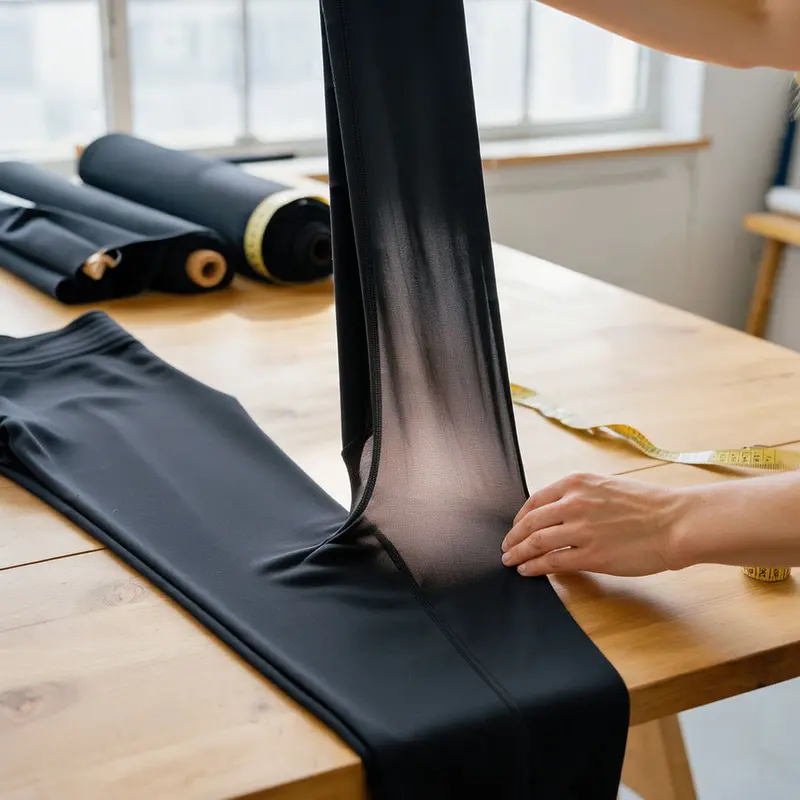
Fabric is where a legging quietly earns your customer’s loyalty or slowly erodes it with every wear. With the Get Low leggings, Lululemon made some very specific material choices that matter a lot more than the hangtag suggests, especially if you’re building your own athleisure line.
At the core is Nulu, a nylon and elastane blend that Lululemon positions as ultra soft and second skin. Conceptually, that’s the same promise many founders chase. You want something that feels weightless but still snaps back, flatters, and survives real-world friction. On paper, a nylon and elastane blend should deliver that balance. Nylon brings strength and a smooth hand feel, while elastane provides stretch and recovery.
The trouble starts when the elastane piece of that equation is weaker than the marketing implies. Independent tests found lower-than-advertised elastane content in some Get Low batches, which directly affects stretch recovery. Less elastane typically means the legging feels fine on first try-on but bags out faster at the knees and seat, and struggles to return to a crisp silhouette after repeated wear.
For a founder, this isn’t just a lab detail. It’s a brand trust issue that ultimately shapes how your customer connects product performance to a broader holistic well-being mindset.
Now compare that with Alo Yoga’s Airlift, which uses a blend that contains 25% elastane. Higher elastane percentages usually create a more compressive, sculpting feel and better snap-back over time. In a competitive context, here’s what’s happening:
- Lululemon’s Nulu-based Get Low leans into softness with a lower reported elastane percentage.
- Alo Yoga’s Airlift pushes elastane content higher, at 25%, to emphasize sculpt and recovery.
- The gap in elastane becomes visible in how the fabrics age and maintain shape.
This list isn’t about copying Alo’s formula. It’s a reminder that your declared fiber breakdown is a strategic decision that customers will eventually feel on their bodies.
Durability under friction is the second red flag. Reports of pilling on the inner thighs after extensive usage tell you that the surface integrity of Nulu in the Get Low is vulnerable where fabric rubs against fabric. Pilling isn’t just a cosmetic problem. It visually signals “worn out” even if the garment is structurally intact, which shortens the emotional lifespan of the product.
Objective testing backs this up. Consumer Reports rated the Get Low’s abrasion resistance at 3.5 out of 5, which is notably lower than the Align’s 4.2 out of 5. For you, this gap translates into a clear question. Are you willing to trade durability for hand feel, or can you engineer a fabric that preserves softness without sliding down the abrasion scale?
Microscopy adds one more layer of concern. After extensive wear, micro-tears in the elastane fibers showed up in the Get Low fabric. Elastane is what allows a legging to stretch and then recover. When those fibers start to tear at a microscopic level, the garment might still look acceptable on a hanger but will feel increasingly loose, less supportive, and more prone to shape distortion.
Strip away the branding and the material story of the Get Low is simple. A soft nylon and elastane blend that feels luxurious at first, but with compromised elastane content and below-flagship abrasion resistance that together shorten its functional and emotional lifespan.
For any founder reading a Lululemon Get Low leggings review through a product-builder’s lens, the real takeaway isn’t that Nulu fails. It’s that small shifts in composition and fiber integrity ripple out into how customers perceive quality, longevity, and value. In the next chapter, we’ll step out of the lab and into the wild to see how these material choices show up in user experience, customer feedback, and visibility issues.
User experience audit: When visibility failures drive misfit and returns

You’ve already seen how fiber choices look under a microscope. Now it’s time to see how those same decisions show up in the real world for a customer trying to buy and wear Get Low leggings.
For a founder, the headline is blunt. Material science is only half of the user experience. The other half is how clearly you set expectations before the first workout, and how honestly your digital touchpoints reflect reality. The aggregated 2024 to 2025 data around Lululemon’s Get Low leggings is a useful cautionary mirror.
Start with fit. Roughly 43% of negative reviews call out poor fit for active use. That’s not just a sizing problem. It’s a misalignment between the product’s promise and the scenarios people actually test it in, like deep squats or high-intensity training. When a customer discovers that misalignment in motion, they feel betrayed, not just inconvenienced.
At the same time, about 12% of reviews explicitly praise the leggings for meeting their squat-proof claims. That split should make you pause. It suggests the product can work as advertised, yet your communication and guidance on who it’s really for aren’t targeting the right bodies, activities, or preferences. The product isn’t failing universally. The funnel that matches the right user to the right use case is.
This is where the digital experience turns into a silent antagonist. Several signals point to a visibility problem that sits upstream of those fit complaints:
- 28% of reviewers felt misled by dynamic promotions in Lululemon’s app that obscured base costs. This erodes trust before anyone’s even tried the product on.
- The app’s seen a 15% return rate tied to hidden pricing and lack of size comparison tools. This signals that customers felt they didn’t get enough clarity to make a confident choice.
- Overall legging return rates jumped 22% year over year in 2024 to 2025 due to inaccurate sizing charts. That’s a direct indictment of the fit guidance embedded in the purchase flow.
Together, these patterns say customers aren’t simply unhappy with fabric or color. They’re reacting to an experience that makes it hard to see the “truth” of the product before checkout. If your own future ecommerce review perception gap review of lululemon Get Low leggings landed in this ecosystem, wouldn’t it likely be shaped as much by the app journey as by the leggings themselves?
That friction gets amplified by what’s missing. Lululemon’s product pages lack robust user-generated fit videos, so shoppers can’t quickly answer questions like “How does this rise sit on someone my height?” or “What happens to opacity when I bend?” Without these quick reality checks, digital fatigue sets in. People scroll, hesitate, then default to returning items that disappoint them in person.
Meanwhile, external observers are noticing. Gartner and Harvard Business Review analyses that recommend friction audits for consumer apps show Lululemon scoring low on visibility. There’s a disconnect between what leadership might see in dashboards and what a confused customer actually experiences in the app.
Inside the ecosystem, things look oddly rosy. Roughly 65% of Lululemon app reviews shown are 5 star. Review gating inflates perceived satisfaction and hides the messy middle, which is exactly where most learning lives. The problem is that this curated optimism clashes with rising frustration. App Store ratings dropped from 4.7 to 4.4 between 2024 and 2025 as complaints piled up.
That perception gap is what should matter most to you as a founder. When public signals trend downward while in-app signals stay suspiciously positive, it becomes very hard to find the real problem and fix it at the root.
In practical terms, a user experience audit for your own brand needs to go far beyond return percentages or star averages. You need to map the journey from first promotion to first workout and ask, at every touchpoint, “Does the customer have enough visible truth to make a confident decision?” The teams that answer that question honestly will be the ones that avoid Lululemon’s spiral of misfit, misled expectations, and mounting complaints.
In the next chapter, we’ll shift from diagnosis to response and look at how operational decisions around returns, support, and product updates either repair this kind of damage or quietly lock it in.
Operational management: When a quality promise trains customers not to trust you

You can only ask “How did they miss this?” for so long before you have to ask a tougher question: “What did they do once the complaints started flooding in?” That’s where operational management either rescues a misfit product or locks in a reputation problem.
With the Get Low leggings, the feedback signal wasn’t subtle. Users called out sagging waistbands, pilling after roughly 10-20 washes, and weak compression. By 2025, 68% of App Store reviews for the product mentioned “bunching” or “see-through” issues. On Reddit, there were over 1,200 threads dissecting defects in the line. If you’re building an athleisure brand, that’s what a blaring alarm looks like.
Yet the way Lululemon operationalized its response turned that alarm into background noise. The brand promoted a visible “Quality Promise” that allowed returns within 30 days, with an extension to 90 days for Elite members. On paper, that sounds like a trust-building safety net. In practice, customers reported denied refunds for “normal wear” and pressure to accept store credit when they expected a simple, direct remedy, a pattern that mirrors broader operational lessons from AI about aligning promises with execution.
As you think about your own roadmap, imagine reading a lululemon Get Low leggings review and realizing the real story isn’t just about fabric. It’s about how the company treated people who felt let down. Every friction point in their process trained loyal buyers to expect resistance instead of help.
Several signals suggest the response apparatus was already under strain:
- Lululemon’s return rate rose to 15% in 2025, up from 12% in 2024, which points to growing dissatisfaction or a widening gap between promise and delivery.
- A 22% cart abandonment rate attributed by Gartner to app-related workflow issues shows operational friction wasn’t limited to defective product handling.
- Structural inefficiencies in post-purchase processes were strong enough to undermine consumer trust, the very asset the Quality Promise was supposed to strengthen.
Taken together, these aren’t isolated operational bugs. They’re symptoms of a system that collects complaints but struggles to turn them into confident resolutions, clear communication, and product iteration. For founders, the takeaway is simple: your return policy, support scripts, and workflow design are part of the product, not an afterthought. In the next chapter, we’ll look at how this kind of operational drag shows up in the numbers and what Lululemon’s trajectory can teach you about the financial impact of delayed or half-hearted course correction.
Market reaction: When missteps only slow the upside
Operational drag in your inbox is annoying. When it shows up in your P&L, it gets very real, very fast.
As a founder, the question under any product misstep or messy review cycle is blunt. Does it actually move the numbers, and for how long? With something like the lululemon Get Low leggings review story, it’s tempting to assume a direct hit to revenue. Yet based on what’s publicly available, there’s no direct evidence that these specific reviews created a measurable financial downturn for Lululemon.
That lack of obvious damage isn’t a free pass. It’s a signal about how resilient premium athleisure brands can be when the broader market winds are at their back. Take India. Lululemon’s confirmed entry on July 15, 2025 drops them into a retail environment that’s already heating up for premium players, supported by well-documented India retail sector growth.
If you were launching an athleisure line there right now, here’s the backdrop you’d walk into:
- In Q1 CY25, India recorded 139 retail deals worth Rs. 32,562 crore (about US$ 3.8 billion). That reflects serious capital confidence in the sector.
- There’s documented positive momentum for premium athleisure in India. Consumers are already primed to pay more for perceived quality and status.
- Trends in retail innovation and credit financed durables show that shoppers are increasingly willing to stretch payments. That makes higher price points easier to absorb.
Put together, these signals change how you read the financial impact of a product stumble. You’re not looking at a single product line in a vacuum. You’re looking at a brand operating in a category with rising average willingness to pay, growing investor interest, and an enabling credit infrastructure.
This is why you should read a rocky product cycle as a drag on upside, not automatically as an existential threat. In a tailwind market, the real cost of operational friction is the growth you didn’t capture while the category expanded around you.
So for a founder, the useful question shifts. “How fast can I turn recovery into renewed capture of market momentum?” Lululemon’s trajectory into India shows you a pattern worth internalizing. Capital flows and consumer trends can create a natural recovery path, but only if your team fixes product and experience issues fast enough to ride those macro currents.
So the financial story here isn’t about a brand getting sunk by one product. It’s about how strong category momentum, strategic market entry, and evolving consumer financing behavior can soften the blow of missteps and create room to recover. Your job is to make sure that when the market gives you that cushion, you’re operationally sharp enough to use it.
Final thoughts
Viewed from altitude, the lululemon Get Low leggings review story is not just about fabric that pills or waistbands that disappoint. It is a chain of cause and effect that runs from marginal elastane decisions to confusing fit communication, from clumsy return handling to a brand perception that drifts out of alignment with reality. Cognitive trust erodes when customers experience a mismatch between marketing and performance, economic drag appears as higher returns and missed margin in a market full of tailwinds, and social proof fractures as curated ratings collide with unfiltered public critique. For a founder, the real lesson is that product, experience, and operations function as one system in the minds of your customers, and that system is only as strong as its least honest link.
The opportunity, however, is just as compounding as the risk. If you treat each negative signal embedded in a lululemon Get Low leggings review as a design brief, you can build fabrics that age with integrity, funnels that guide the right body to the right use case, and operational pathways that turn dissatisfaction into evidence of your reliability. The brands that win the next phase of premium athleisure will be the ones that turn transparency into an asset and iterate faster than the market loses patience. The question is whether you will wait for your own noisy review cycle to force that discipline, or whether you will use this retrograde case study as a catalyst to design a more resilient product ecosystem now.
Ready to upgrade your everyday life with smarter choices and inspired living? Contact OnInitiative.com ([email protected]) today and let our experts help you design a lifestyle that aligns with your goals and values!
About us
OnInitiative.com is a digital innovation partner that empowers professionals and organizations to design smarter, more fulfilling lifestyles. Through custom software solutions, productivity tools, and travel-tech integrations, we help people reclaim time, reduce stress, and make the most of every moment, whether at work, home, or on the road.
Further reading


Leave a comment