
















No products in the cart.

Shop this story
AI Logistics for E‑Commerce Fulfillment in 2025
by Joseph L
AI logistics for e‑commerce fulfillment is reshaping how retailers keep promises to shoppers, turning delivery nightmares into predictable outcomes. Real‑time routing, autonomous warehouse robots, and generative AI are no longer experiments—they’re the new baseline for speed and accuracy.
Professionals will see why these technologies matter as we explore dynamic routing that cuts delays, inventory intelligence that drives 5‑6% sales growth, cross‑border automation that slashes costs, and the critical gaps that still threaten seamless fulfillment. Each chapter uncovers the data, the tools, and the strategic actions needed to stay ahead in 2025.
AI Logistics 2025: Real-Time Routing Slashes E-Commerce Delivery Delays

Imagine a temperature-sensitive pharmaceutical shipment navigating rush hour traffic. One wrong turn risks spoiling life-saving medicine. By 2025, real-time AI logistics transforms this high-stakes scenario for e-commerce fulfillment, dynamically adjusting routes mid-transit to turn potential disasters into seamless deliveries.
Warehouse floors showcase this shift most vividly. Operators deploy AI-powered Autonomous Mobile Robots (AMRs) that continuously optimize paths, with Locus Robotics’ self-healing units reducing route conflicts by 43% and Omron’s vision-enabled models dynamically reconfiguring around obstacles. Nineteen new models launched in 2024-2025 alone demonstrate the industry’s rapid evolution through a forward-looking AI business strategy 2025, collectively achieving 98% navigation accuracy in complex environments and transforming fleet coordination from logistical challenge to seamless operation.
This precision extends beyond warehouse walls. Girteka Logistics’ dynamic routing system integrates weather, traffic, and historical data to slash delivery delays by 22% for perishable goods, simultaneously cutting fuel consumption by 15% while maintaining strict temperature compliance.
Transport Canada and U.S. Customs prove real-time routing’s continental value. Their AI border system analyzes traffic feeds and social media to predict wait times with 92% accuracy, reducing cross-border delays by 35% and keeping North American just-in-time supply chains intact.
Through predictive disruption alerts, these systems fundamentally transform dispatcher-driver communication. Continuous real-time path optimization has evolved from convenience to the non-negotiable foundation of reliable delivery.
While smarter routing solves today’s delivery headaches, the next frontier requires equally intelligent inventory management to eliminate stockouts.
AI Logistics Advantage: 5-6% Sales Growth with Smarter Inventory
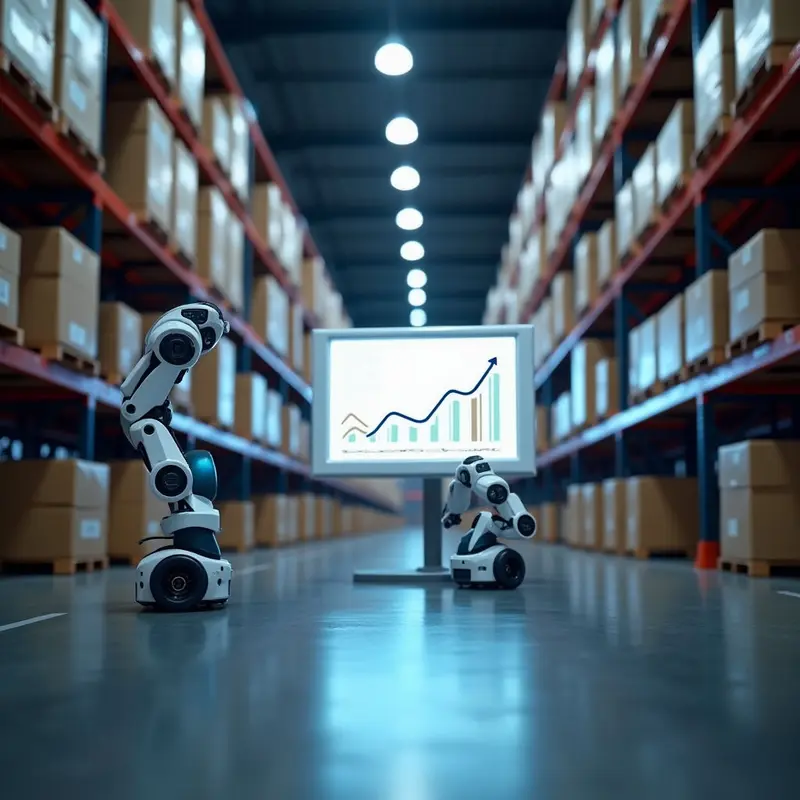
Retailers once faced frustrated customers clicking away due to out-of-stock items—a problem now solved by AI logistics that boosts sales growth by 5-6%. The transformation stems from inventory intelligence anticipating needs before they arise, turning reactive guesswork into precision.
Recent implementations prove this shift. Predictive analytics processes historical sales patterns, weather disruptions, and local event impacts. Such capabilities are now operational across global networks, where Microsoft Dynamics 365’s Copilot integration unifies siloed data to dynamically adjust stock placement. Early adopters report immediate benefits: reduced operational costs, fewer manual errors, and enhanced customer satisfaction.
This precision directly fuels revenue through responsive pricing strategies. By analyzing competitor pricing and demand signals in real time, AI clears slow-moving stock while protecting margins—slashing stockouts by 22% and cutting excess inventory by 18% according to the 2024 Supply Chain Dive demand forecasting report.
These efficiency gains compound into a virtuous cycle: reduced holding costs and eliminated stockouts free capital for high-demand products. As the industry accelerates toward its projected $85.3 billion market valuation by 2032, one truth emerges—smarter inventory isn’t just optimizing today’s operations; it’s laying the quantitative groundwork for tomorrow’s explosive market expansion.
Generative AI Reduces E-commerce Delivery Delays by 27%

Imagine a logistics manager navigating last holiday season’s chaos—weather disruptions and port gridlock threatening delivery promises. Generative AI has transformed this scenario, enabling major retailers to reduce shipment delays by 27%. This means one in four previously late packages now arrives precisely on schedule. The technology achieves this by processing historical and live data across 12,000+ global trade routes to anticipate disruptions like hurricanes or container ship bottlenecks.
These improvements extend far beyond delivery windows:
- Freight optimization platforms cut fuel consumption by 18% through dynamic carrier matching
- North American trucking networks saw on-time deliveries jump 27%
- Omnichannel retailers achieved 30% labor cost reductions via autonomous inventory systems
Collectively, these advances fueled a $15.2 billion surge in the AI logistics market between 2023-2025, with generative AI contributing $6.1 billion. North American providers drove 65% of this growth as adoption rates soared from 29% to 68% year-over-year, while venture capital invested $2.9 billion in AI business tools that create interoperable platforms connecting maritime, air, and ground networks.
For logistics professionals, this shift means replacing emergency firefighting with strategic oversight. Generative AI converts complex variables into optimized routes, transforming supply chain volatility into predictable outcomes—paving the way for automated warehouse ecosystems that revolutionize order fulfillment.
AI Logistics: Faster, More Accurate E-commerce Fulfillment
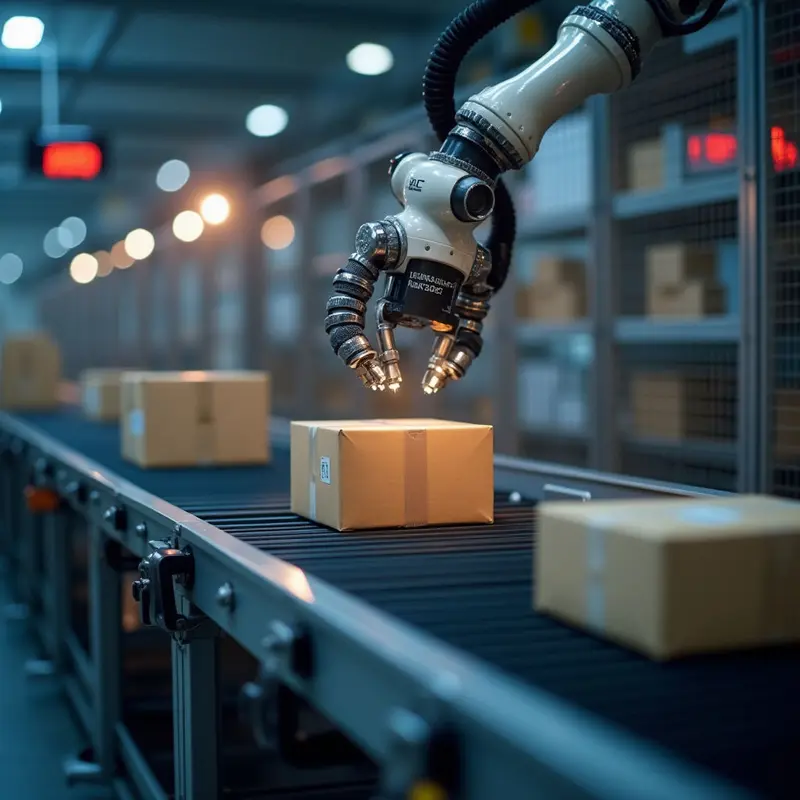
The global logistics automation market reached USD 78.20 billion in 2024, signaling a decisive shift as e-commerce giants abandon error-prone manual fulfillment. Warehouse professionals now confront dual pressures: soaring operational costs demand optimized space utilization, while customers insist on flawless same-day delivery.
Three recent implementations prove this transformation is operational reality:
- Sharp’s thin-profile stacking robot system (Q1 2025) overcomes narrow-aisle constraints, boosting storage density by 22% and improving picking speed without costly retrofits, while maintaining 99.8% order accuracy
- ByteDance’s fleet of 1,000+ AMRs uses real-time algorithms to navigate complex layouts, cutting package transit time by 35% for SF Express
- SSI SCHAEFER’s European hub achieved 40% faster order processing through AGVs and WAMAS® software, sustaining 99.99% inventory accuracy across shifts
These solutions collectively demonstrate how automation directly addresses rising warehouse costs and labor challenges. They reduce workplace injuries by minimizing manual handling while increasing employee satisfaction through strategic task allocation.
Integrated with ERP platforms, such systems eliminate manual data entry and slash transportation costs by 18%. For warehouse managers, the ERP integration benefits mean avoiding costly chargebacks from misfilled orders and gaining capacity for strategic scaling.
This reliability revolution satisfies shoppers while creating the foundation for AI-driven cross-border fulfillment—where synchronized global networks must now navigate customs complexities and regional compliance demands.
AI Logistics Streamlines Cross-Border E-commerce Fulfillment

Building on the reliability revolution described previously, small manufacturers now ship handmade goods directly to Berlin—eliminating intermediaries through AI logistics for e-commerce fulfillment. Just two years ago, customs delays and unpredictable costs made this nearly impossible. Today, real-time consumer data drives low-volume, high-frequency production tailored to international markets, slashing inventory costs by up to 35%. When the U.S. terminated its $800 de minimis exemption in August 2025, small manufacturers faced 60-hour delays and 22% higher costs for sub-$800 shipments. AI became their lifeline.
Beyond documentation, AI transformed operational logistics. Automated tariff classification tools integrated by Amazon and Walmart reduced compliance errors by 75%, adapting to the EU’s new small-parcel import rules while processing multi-currency transactions 82% faster. Failed payments dropped to just 1.7%. Simultaneously, AI-optimized chartered flight networks consolidated shipments across manufacturers, cutting air freight costs by half. Routes adjusted hourly based on customs clearance data and geopolitical risks, helping JD Metal Crafts achieve 98% on-time European deliveries.
Indian retailers similarly leveraged agentic AI, reducing stockouts by 63% and inventory costs by 41% through micro-fulfillment optimization. Platforms now sync production data with live demand across 12 markets, triggering replenishment within two hours for fashion and electronics.
This isn’t theoretical. Thirty-seven percent of Fortune 500 manufacturers adopted chartered flight networks by early 2025, while payment platforms like BriskPe, which utilize AI budgeting tools, secured $217 million to fix cross-border bottlenecks.
Yet scaling these systems demands careful navigation of complex integration hurdles as seasonal volatility and regional compliance rules strain traditional supply chains.
3 Critical AI Logistics Gaps Derailing E-commerce Fulfillment

Imagine your entire e-commerce fulfillment operation collapsing overnight when a compromised SAP NetWeaver system locks critical warehouse management software. This exact scenario—documented in Bright Defense’s May 2025 report—disrupted 581 global enterprises. The root cause? Poor patch management and insufficient integration testing. Such breaches now cost organizations $9.44 million per incident on average according to IBM’s 2024 analysis, directly threatening fulfillment continuity.
These operational vulnerabilities expose three critical gaps derailing AI-driven fulfillment operations:
- Implementation expertise shortages causing standalone AI deployments without external support
- Inadequate change management failing to prepare warehouse staff for new workflows
- Integration failures between legacy systems and new AI tools
The staggering 95% failure rate in generative AI pilots (per MIT’s August 2025 study) stems not from flawed algorithms, but precisely these gaps. Organizations waste resources on quick fixes despite the AI pilot failure rate, while unpatched systems like SAP NetWeaver remain exposed.
Short-term fixes won’t suffice. The UK’s 2025 Cyber Growth Action Plan offers a blueprint by linking cybersecurity startups with government departments through structured pilots, directly addressing the workforce development crisis in AI implementation.
True fulfillment resilience requires closing these gaps immediately. Without integrating security updates with legacy infrastructure and building practical AI expertise, even advanced systems remain vulnerable to cascading failures that halt orders completely.
Final thoughts
Across the six chapters, the story is clear: AI‑driven logistics delivers faster routes, smarter stock placement, and tighter cross‑border coordination, while also exposing three systemic vulnerabilities—skill shortages, change‑management blind spots, and integration failures. When organizations bridge those gaps, the combined effect is a resilient fulfillment network that fuels revenue growth and trims waste.
The takeaway for today’s professionals is simple yet powerful: mastering AI logistics for e‑commerce fulfillment isn’t optional—it’s the cornerstone of future competitiveness. As AI models become more predictive and integration frameworks more secure, the question isn’t whether you’ll adopt, but how quickly you’ll turn these capabilities into a sustainable advantage.
Ready to elevate your business with data-driven strategies and expert insights? Contact OnInitiative.com ([email protected]) today and let our team help you grow smarter, faster, and more efficiently!
About Us
OnInitiative.com is an innovative marketplace that helps e-commerce businesses boost productivity and community growth through advanced automation tools.
Get Free $200 Perplexity Pro via PayPal and Venmo
Sep 22, 2025
Further reading


Leave a comment