













No products in the cart.

Shop this story
Delete wellness clutter: 5 capsule upgrades high achievers need
by Elizabeth H
High achievers are not short on information, tools, or advice about performance; they are buried in it. The real cost is not just money spent on the latest wellness gadget, it is attention scattered across disconnected routines that rarely add up to meaningful change. When every new recommendation promises an edge, the result is often a cluttered stack of habits and devices that generate more noise than signal. The question that matters is which minimalist wellness essentials actually govern your energy, focus, and resilience, and which can be safely deleted.
For professionals who operate with tight calendars and high cognitive demands, wellness strategy has to function more like system design than self-care entertainment. What counts is the small set of upgrades that convert invisible physiological processes into clear, actionable feedback, calm the nervous system on demand, and protect scarce attention from constant digital intrusion. This article analyzes those leverage points, from sleep and stress regulation to digital boundaries and behavioral governance. The goal is not to add more to your plate, but to define a compact infrastructure that quietly supports sustainable high performance.
1) Smart ring sleep analytics: Your daily energy governance briefing
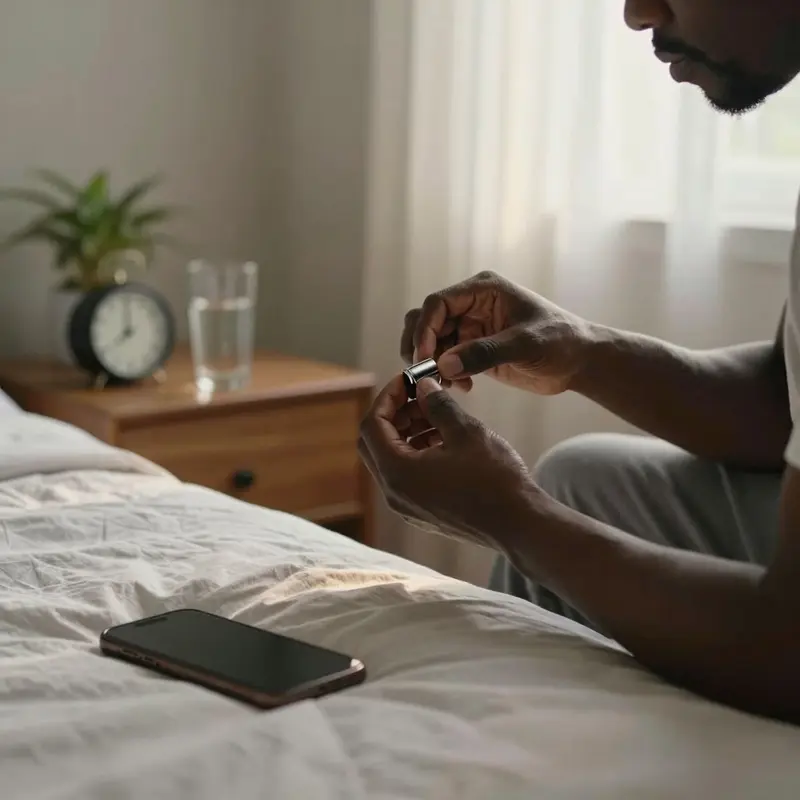
If you want to strip away wellness clutter, start with the one metric that quietly runs everything you care about: sleep. For a high achiever, it’s not a wellness hobby. It’s the operating system that decides whether your cognitive performance compounds over time or slowly erodes.
A smart ring that focuses on sleep turns that invisible operating system into a clear, daily briefing. Devices in the Oura-inspired category sit on your finger and run 24/7 physiological monitoring. Oura, for example, uses 18 light paths, dual temperature sensors, and motion tracking so it can watch your body continuously without pestering you for attention. The ring monitors sleep at 250 Hz, which means it’s capturing very fine-grained signals throughout the night.
The output stays intentionally simple. You wake up to daily Sleep, Readiness, and Activity scores. Instead of scrolling through dozens of charts and graphs, you get a distilled answer to one question: “Do I have the physiological budget to push today, or should I prioritize recovery?” If you’re managing teams, deals, or non-negotiable deadlines, that single point of clarity can keep you from making the most expensive mistake of all, which is plowing through a day your body isn’t equipped to handle.
Underneath those scores, there’s recovery analysis built on heart rate variability and temperature trends. When HRV holds steady and temperature sits in your typical range, the ring signals more capacity for deep work and serious training. When it detects deviations, it nudges you to treat the day as a recovery asset instead of another performance test. Over a few weeks, that pattern recognition trains you to see the link between late nights, alcohol, travel, or overtraining and your next-day execution.
This is where the ring earns a spot among minimalist wellness essentials. You’re not adding another app you need to babysit. You’re replacing guesswork with a single, always-on instrument that quietly fits under your existing routines and tells you when they’re working and when they’re quietly taxing your system.
For women, Oura-type devices add another layer of relevance through prediction features tied to women’s health. Cycle-related shifts in temperature and physiological patterns can help you anticipate phases of higher or lower energy. That context can be critical when you’re planning presentations, negotiations, or strategic sprints that demand your best cognitive output, and it pairs well with external wellness technology guidance when you’re deciding how much tech you actually want in your stack.
The platform effect matters too. Oura is expanding into metabolic health assessments through integration with Dexcom. That kind of connection brings glucose data into the same behavioral loop as sleep and recovery. For a busy professional, this convergence means you spend less time trying to stitch together partial dashboards and more time acting on integrated signals that are already aligned with your actual behavior.
Two market signals should give you confidence that this category isn’t a fad. Oura has sold over 1 million units by 2023, which reflects strong consumer adoption. The broader smart ring market is projected to grow from 125 million dollars in 2023 to 747 million dollars by 2030, largely driven by demand for unobtrusive sleep tracking.
In practical terms, a smart sleep-focused ring isn’t about biohacking. It’s a governance tool for your energy. It turns sleep, strain, recovery, and in some cases metabolic data into a simple daily briefing you can actually use. Once your nights are working for you, the next leverage point is how you regulate your nervous system during the day, which is where targeted tools for the vagus nerve start to matter.
2) Vagus nerve reset tool: On-demand stress downshift

After optimizing your nights with a smart ring, the next critical focus is the system that governs your daytime reactions, your nervous system.
If you’re a high achiever, stress never feels theoretical. It shows up as shallow breathing before a board meeting, as racing thoughts at 3 a.m., and as a body that feels “on” when you desperately want “off.” So the practical question is not how to escape stress, but how to regulate it with minimal friction, clutter, and decision fatigue.
That’s where a focused vagus nerve tool becomes a true minimalist wellness essential. Instead of adding another 40-minute routine to your calendar, a device like Pulsetto condenses nervous system support into a few targeted minutes that actually fit between meetings, flights, or deep work blocks.
Pulsetto is a non-invasive, app-controlled wearable that’s designed for stress regulation, sleep improvement, and activation of the parasympathetic nervous system. In plain language, it’s built to help your body shift out of fight-or-flight and into rest-and-recover. As a science-backed vagus nerve device, it does this through customizable electrical impulses that you can direct toward stress reduction, sleep support, focus, or recovery.
The workflow is intentionally simple, which matters when your schedule’s already packed. You apply electrode gel to your neck. You position the lightweight, rechargeable, Bluetooth-enabled device. Then you start a session through the app. Sessions typically last 4 to 10 minutes. Inside the app, you can track your usage, which matters if you like to correlate inputs such as session timing with outcomes like sleep quality or next-day focus.
For a clutter-free operator, the key advantages are consolidation and predictability:
- It reduces the need for a stack of scattered wellness rituals, since multiple goals like stress relief, sleep support, and recovery are addressed in one device.
- It’s portable and app-controlled, so it fits into a travel bag or desk drawer instead of requiring a dedicated space.
- It’s marketed as an affordable one-time purchase without subscriptions, which removes another recurring charge and login from your mental load.
Although individual responses vary, Pulsetto reports 86% user satisfaction among more than 100,000 users for stress relief and sleep improvement. That figure signals that most users perceived a meaningful benefit, especially in domains that are notoriously hard to shift, such as sleep quality under stress.
Reported effects include improved heart rate variability, reduced cortisol and inflammation, and boosted neurotransmitters. For a performance-driven professional, these aren’t vague wellness buzzwords. They point to a body that can downshift after intense effort, repair more effectively, and stay responsive rather than reactive in high-stakes conversations and negotiations.
There’s also a governance benefit that appeals to operators who think in systems. Because Pulsetto is FDA-registered for general wellness and doesn’t require subscriptions, it behaves more like an infrastructure upgrade for your nervous system than a hobby gadget. You set up the device once. You define when you tend to use it. Then you let brief sessions become part of how you open or close intense blocks of work.
With a calmer baseline established, the next challenge is protecting that state from constant digital intrusion so your nervous system remains balanced. This requires deliberate management of your boundaries, inputs, and focus: equally important as the tools you integrate.
3) Digital boundary blocker: Reclaim 2-3 hours of deep focus

With a foundation of calm already in place, digital boundaries now emerge as a critical component for maintaining focus. The real threat isn’t a lack of resilience; it’s the constant drip of notifications, pings, and “I’ll just check this one thing” that keeps your brain in a low-grade alert state. Digital boundaries aren’t a nice bonus anymore. They’re a core part of your focus hygiene.
For a high performer, the real scarcity isn’t tools or information. You already have more of both than you can realistically use. What you don’t have is uninterrupted, high-quality attention. That’s why digital boundary blockers deserve a place in your minimalist wellness essentials, sitting right alongside broader shifts like the digital decluttering wellness trend. They turn vague intentions like “I should focus more” into hard conditions where distraction simply isn’t available.
Several tools already do this extremely well:
- Freedom blocks sites and apps across your devices. You can create custom block lists, set recurring schedules, and line them up with deep work sessions so distractions never even show up in the first place.
- Brick is a physical device that cuts average screen time by 3.1 hours a day and has been linked to a 95% reduction in distractions in one survey. It externalizes your commitment so your phone physically isn’t an option during focus blocks.
- Roots uses a dopamine detox approach and can save over 2 hours a day that would otherwise vanish into compulsive scrolling. It helps retrain your brain’s reward patterns instead of relying on sheer willpower.
- StayFocusd is a Chrome extension with a “Nuclear Option” that blocks all non-work sites when you need to lock in. When you flip that switch, your browser effectively becomes a work-only environment.
- Opal and StayFree monitor and block usage, cutting screen time by roughly 20 to 50 percent. They give you both the data and the guardrails so you can see your patterns and interrupt them in real time.
- Motion AI automates time blocks so your calendar reflects your actual focus needs instead of wishful thinking. It doesn’t just show you when to work. It structures your day to protect that work from constant digital friction.
Used together, these tools can reclaim 2 to 3 hours a day for deep work and real presence. For a high achiever, that’s the difference between feeling like you’re perpetually behind and feeling like you’re finally ahead of your own life.
You can treat this the same way you’d treat any other performance system. First, identify which channels hurt your focus the most. Is it your browser, your phone, notifications, or the constant pull of social apps? Then choose the lightest tool that’ll reliably interrupt those specific patterns. If Chrome is your main leak, StayFocusd might be enough. If your entire device feels like a temptation, something like Freedom or Brick gives you a much harder boundary.
The emotional shift from this is significant. When you make the decision to “resist” distraction once, in your settings or in a physical device, you stop negotiating with yourself every five minutes. That single structural choice cuts decision fatigue and protects the calmer nervous system you’ve worked hard to build.
By establishing clear digital management, you create an environment where focus, rest, and real recovery become the norm, supporting a higher level of sustained energy. This paves the way towards understanding how one specific fermented prebiotic can bolster your gut health for consistent performance.
Final thoughts
When you look at the full picture, a coherent pattern emerges. The most effective wellness investments for high performers are the ones that transform vague intentions about rest, composure, and focus into measurable, repeatable systems. Sleep data becomes a daily briefing that shapes decision making, stress regulation shifts from a vague aspiration to a precise protocol, and digital boundaries turn attention from a liability into an asset. Taken together, these moves convert wellness from a scattered collection of tactics into a tightly governed operating system for your cognitive and emotional bandwidth.
The practical implication is clear, minimalist wellness essentials are less about owning more tools and more about curating a small, interoperable stack that you actually use. Each selected upgrade should remove friction, compress decision making, and return time or energy that you can redeploy into meaningful work and recovery. As you evaluate your own routines, the key question is not what you could add next, but what you can strip away so that the few things that remain carry disproportionate leverage over how you feel and perform a year from now.
Ready to prioritize your well-being with expert-backed wellness strategies? Contact OnInitiative.com ([email protected]) today and let our team help you build a healthier, more balanced lifestyle, inside and out!
About us
OnInitiative.com is an innovative marketplace that helps e-commerce businesses boost productivity and community growth through advanced automation tools. By connecting companies with tailored wellness and productivity solutions, OnInitiative.com empowers organizations to enhance employee health, reduce burnout, and foster a more engaged digital workforce.
Further reading

Leave a comment