













No products in the cart.

Shop this story
Redesigning wearable health routines after early missteps for older adults
by Anabel Figueroa
Most wearable programs don’t fail because the sensors are wrong. They fail because the daily routine is. For digital health designers, wearable health habits for seniors are where good intentions meet real constraints, shaky confidence, and a low tolerance for friction.
Redesigning after early missteps means getting honest about what you’re measuring, what anyone can act on, and what older adults will actually live with every day. The work starts with disciplined signals, then moves into safe remote adjustments, smarter validation across the home and care ecosystem, and interfaces that feel calm instead of demanding. If you can make the system explain itself and stay stable across changing devices, you can turn “trial” into “routine.” That’s the difference between data collection and durable care.
Audit: Defining actionable health metrics for seniors

You’re designing a wearable reboot for older adults. Your first job is simple: define what “healthy” means in signals you can measure before the product starts guessing.
Start the audit with metrics that wearables can capture reliably and that seniors will actually tolerate every day. You’re not trying to collect everything. You’re choosing a small set that can spot risk early, support independence, and stay easy to interpret for clinicians and caregivers.
When early deployments fail, it’s often because the system tracked what was easy, not what anyone could act on.
Map senior health habits to a few core data streams that can move across devices and create a stable baseline:
- Heart rate and related patterns that can flag meaningful changes against a person’s own norms.
- Activity levels that reflect mobility and routine, not just fitness goals.
- Sleep patterns that show recovery, fragmentation, and day to day resilience.
- Stress and biometric tracking that helps explain why a day looks off even when steps are normal.
Next, widen the audit to the ecosystem that will carry these metrics. GPS watches and smart pill dispensers can push the story from wellness into independence by combining location awareness with medication adherence. That’s often where routines break first.
You’re building for a market where geriatric patients are driving demand, including IoT connected sensors embedded in smart garments. These can make monitoring feel less like a gadget and more like clothing.
One inflection point is close: by 2026, hearing aids are expected to monitor health metrics alongside audio adjustments. Your metric definitions need to hold up across new form factors, new contexts, and new privacy expectations.
Keep the audit disciplined and device tuning becomes a controlled experiment, not guesswork. That puts you in a position to adjust settings remotely with confidence and accountability.
Adjustment: Making remote tuning a safe, repeatable workflow
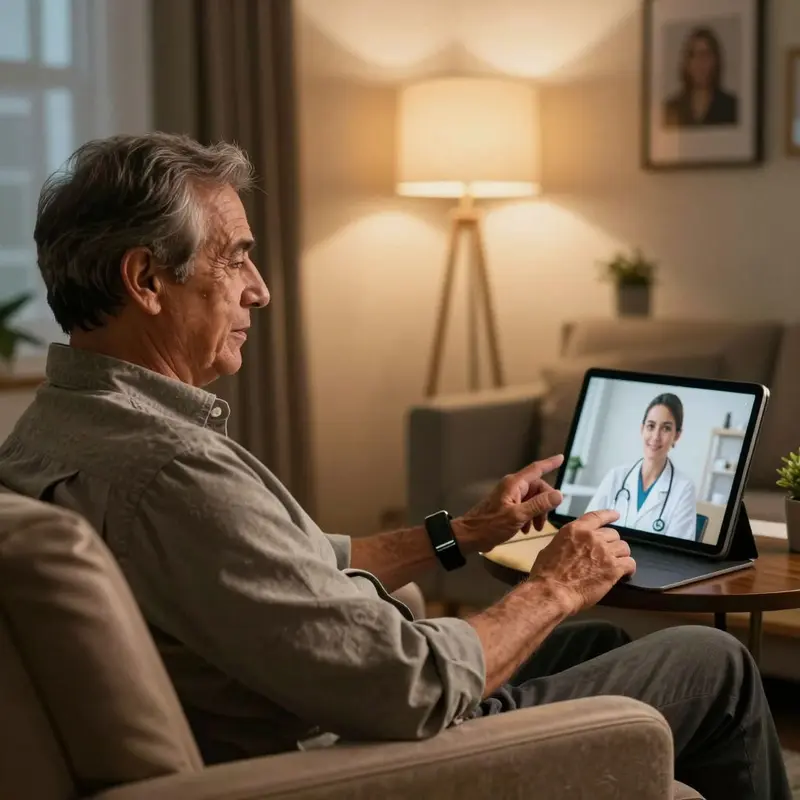
If you treat tuning like a controlled experiment, remote adjustment stops feeling like a risky convenience. It becomes a repeatable clinical workflow.
The basic pattern is straightforward. Define what “better” means. Then change one setting at a time from a distance and watch for the same improvement to show up again in daily life. For wearable health habits for seniors, repeatability is the difference between a device that gets abandoned and one that becomes quietly indispensable.
Remote tuning matters most when in-person support is hard to get. Wearables paired with telehealth already enable remote patient monitoring for older adults in rural areas. That same setup can also carry your tuning decisions back to the device without waiting weeks for a visit.
Treat every remote tweak as a three-part contract.
- Interaction: prioritize gesture and voice-based remote controls so adjustments can be confirmed without hunting through menus, especially when dexterity or vision varies day to day.
- Form factor: design your settings model to survive beyond a wrist device, since smart garments can stream biometrics for telemedicine and will demand the same clarity about what changed and why.
- Feedback loop: tie each change to a short, time-boxed check-in so the person’s lived experience is captured alongside the sensor signal.
Audio is where this gets real. With AI-driven real-time sound adjustments expected in hearing aids by 2026, your remote control layer cannot be a one-off tool. It has to coexist with on-device automation so humans can set boundaries, review outcomes, and roll back safely when the algorithm’s “better” does not match the wearer’s.
The goal is not maximal personalization. It is stable, explainable change at a distance.
Build that discipline now and you will be ready to combine AI with what the environment knows too, including cues from the home that can confirm whether a tweak helped or simply shifted the burden elsewhere.
Integration: Using AI and home sensors to validate change

If you can ship stable, explainable updates remotely, the next step is clear: let the environment validate the change, not just the wearable.
Treat AI as an integration layer, not a magic brain. When a wearable suggests a tweak, ask a harder question: what else can confirm it helped? That move is what keeps senior health habits from turning brittle. Instead, you build routines that hold up through bad days, noisy data, and imperfect adherence.
AI-enhanced hearing aids are trending toward this kind of partnership by 2026, with real-time sound adjustments alongside biometric tracking. That pairing matters because it links what someone feels in the moment to what their body shows over time. You get a tighter feedback loop to judge whether an algorithmic “improvement” reduced strain or just moved it somewhere else.
Next, widen the circle. Sleep trackers can share data in real time with smart beds, and AI can personalize both sides. When it works, the benefits are practical: the bed’s context helps explain the wearable’s sleep signal, and the wearable’s longer-term trend keeps the bed from overreacting to one restless night.
Integration should make the system more humble.
In care settings, smart garments with IoT can assess pressure ulcer risk. That turns passive monitoring into an early warning teams can act on before a crisis. At home, voice assistants paired with GPS wearables add a safety layer that can escalate help when patterns look wrong, while keeping day-to-day interaction low-friction.
The design test is simple: every new sensor you add must reduce uncertainty, not add noise or burden. Get that right, and the next challenge is obvious: make the combined experience feel effortless through simpler, clearer interfaces.
Usability: Making invisible interfaces that older adults trust

Cut the interaction cost: fewer choices, clearer feedback, and as much hands-free control as you can responsibly deliver.
Treat the interface as the real “wearable,” not the sensors. When older adults hit friction, they do not just quit a screen. They quit the habit. Usability for wearable health habits for seniors isn’t about nicer icons. It’s about removing the moment where someone has to wonder, “What do I do now?”
Start by offloading intent to modalities that fit real life. Voice controls can turn a tiny, fussy UI into a simple conversation. AI adjustments can adapt in real time so common actions stay hands-free instead of becoming a daily tap marathon. The payoff is relief and confidence. The device feels like it’s working with the person, not testing them.
Tighten every feedback loop. If the system changes behavior, it has to explain itself in plain language with calm signals. Otherwise adaptive interfaces can feel like they’re “moving the buttons,” and users lose trust because they don’t know what changed.
Make the simplest path the default path.
Look at where wearables are already headed. The push toward 2026 hearing aids that blend AI-driven biometric monitoring with Bluetooth connectivity shows what “invisible interaction” looks like when it’s done well: familiar hardware, always present, and socially acceptable.
Home care points to the same principle. Discreet wearables that track biometrics and help prevent pressure ulcers work best when the device stays unobtrusive and the interface stays quiet. People accept it as part of daily living instead of a constant reminder of risk.
Design the interface so the smartest features feel like the easiest ones. Then you’ve earned the right to ask for consistency over time, as you shift toward building long-term adherence through routines that last.
Sustainability: Engineering repeatable adherence with calm, personalized support
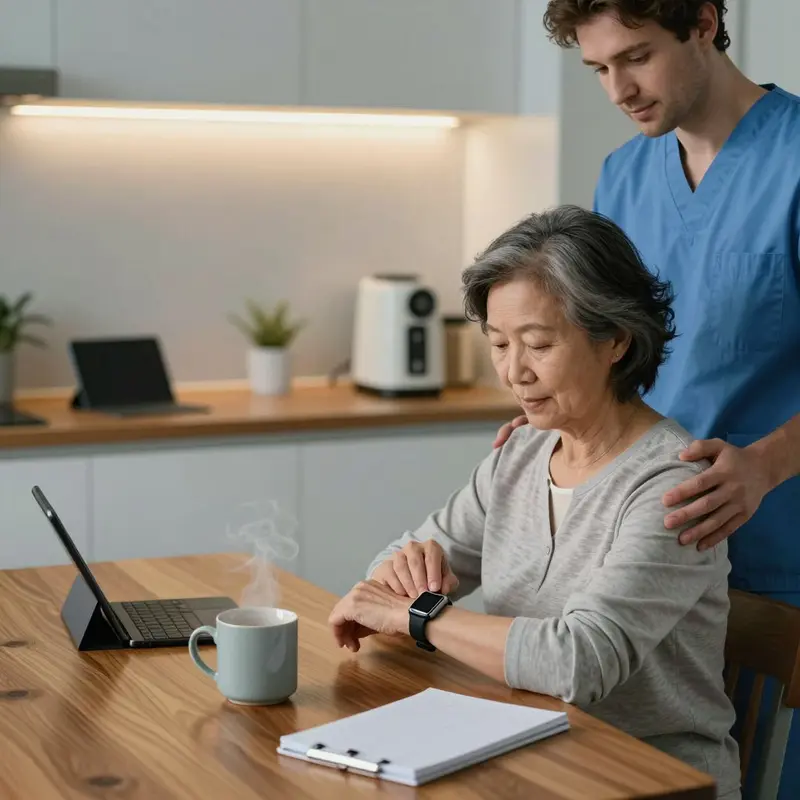
Design adherence as a product feature, not a character test. When the device feels like “part of the day,” that is the start line. Your real job is making tomorrow happen again, even when motivation drops.
Start with onboarding that is personal and calm. Do not dump every feature on day one. If setup adapts to someone’s chronic condition needs and daily constraints, you cut early friction that leads to abandonment. You also earn trust before you ask for consistency.
Telehealth can be the bridge between data and meaning. In the Medicare ACCESS model, adding telehealth to personalized onboarding for chronic conditions reduced early drop-off rates. Not because calls are magic, but because someone helps interpret signals and adjust the plan while habits are still fragile.
Adherence gets easier when support shows up at the moment attention is actually available.
Next, make reminders feel like guidance, not nagging. AI-enhanced reminders can time prompts to real behavior. When AI-enhanced wearables connect to patient registries, the data becomes useful in real time for chronic disease management. That gives clinicians and care teams a reason to act, not just watch.
Do not ignore the two biggest friction points: high costs and tech discomfort. You might not control pricing, but you can design for the drop-off it causes. Emphasize gradual habit-building. Invite family involvement so setup, charging, and interpretation do not land on one person.
This is how wearable health habits for seniors stop being a “device experience” and become a durable care loop. Anchor onboarding in personalization, reinforce it with telehealth, and use AI to prompt and interpret in context. Then you stop chasing adherence and start engineering it.
Final thoughts
When you rebuild a wearable routine for older adults, the win isn’t more data. It’s fewer guesses. Start with metrics that map to real decisions, then treat every change as a controlled, trackable adjustment that can be rolled back. Use the environment to confirm whether the wearable’s story matches lived reality, and keep the interface quiet enough that the habit survives a hard week.
The most reliable systems feel almost boring. They’re predictable, explainable, and respectful of attention. If you design for calm onboarding, low-friction control, and support that shows up at the right moment, wearable health habits for seniors stop being a “device experience” and become part of everyday care. As new form factors and automation arrive, will your next iteration make routines simpler, or just make complexity easier to hide?
Ready to upgrade your everyday life with smarter choices and inspired living? Contact OnInitiative.com ([email protected]) today and let our experts help you design a lifestyle that aligns with your goals and values!
About us
OnInitiative.com is a digital innovation partner that empowers professionals and organizations to design smarter, more fulfilling lifestyles. Through custom software solutions, productivity tools, and travel-tech integrations, we help people reclaim time, reduce stress, and make the most of every moment, whether at work, home, or on the road.
Further reading


Leave a comment