








No products in the cart.

Shop this story
The subtle risk of choosing an EEG headband over an HRV bracelet
by Elizabeth H
Buying a wellness wearable feels like choosing truth. But in the EEG headband vs HRV bracelet debate, “more direct” doesn’t always mean “more helpful.” One sits on your wrist and watches your body’s stress rhythms. The other sits on your head and reports on the place where worry already lives.
That’s where the subtle risk shows up. Brain data can feel like the final word, even when it’s just one noisy slice of a complicated day. If you’re already prone to overthinking, a constant stream of mental-state scores can quietly shift from insight to surveillance. The device still works. The trouble is what it trains you to trust, and what it trains you to doubt.
Psychological impact: When brain data fuels anxiety
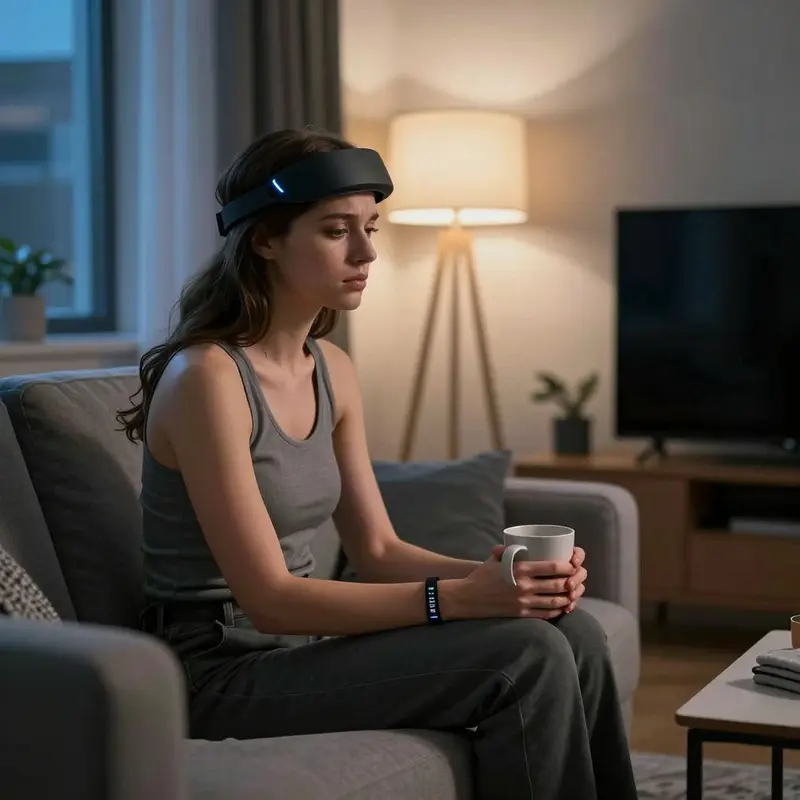
For wellness-curious wearers, the appeal of putting a brain-reading device on your head is almost self-evident. You want insight, you want precision, and the EEG headband promises both: a direct window into the electrical patterns your brain produces when anxiety takes hold. That promise is real. The problem sits just underneath it.
EEG technology does detect stress-linked brain activity with genuine accuracy. When cognitive pressure builds, the electrical signatures shift, and a well-calibrated headband can surface those changes before you’ve consciously registered them. Compared to an HRV bracelet tracking your heart’s rhythmic variation, the EEG’s specificity can feel like an upgrade. More data, more granularity, more clarity about what’s happening between your ears.
But specificity cuts both ways.
When a device gives you richer feedback about your anxiety, it also gives you more to watch, more to interpret, and more to worry about. There’s a documented risk pattern in EEG use where the same precision that makes the technology compelling starts to encourage fixation on neural fluctuations that, in most cases, are entirely ordinary. A reading spikes slightly after your morning coffee. Your focus score dips during a difficult call. Without clinical context, these signals can turn into a source of low-grade concern rather than actionable guidance.
This is where the comparison between an EEG headband vs HRV bracelet becomes psychologically meaningful, not just technically interesting. An HRV bracelet measures a slower, more systemic signal. It nudges you toward recovery habits like sleep, breathing, and movement. An EEG headband, by contrast, keeps your attention on the cognitive surface, on the very mental state you’re already anxious about. The feedback loop this creates isn’t always corrective. Sometimes it’s self-reinforcing.
Dependency is the word that doesn’t appear often enough in device marketing. When a tool is effective at detecting your anxiety, you can start to trust it more than your own subjective read. Over time, you may find yourself checking the headband before deciding whether you’re stressed, rather than checking in with yourself. The bias introduced by the EEG’s efficacy is subtle precisely because the device is doing its job. It’s detecting something real. The distortion comes not from inaccuracy, but from overreliance on a signal that was always meant to inform, not to govern.
None of this makes EEG technology harmful by default. It just makes the choice of device a decision with psychological stakes that most product descriptions don’t surface. The real audit starts when you look at how that choice lands day to day, and whether the setup and daily experience of each device actually supports or undermines your intentions.
User experience audit: How friction quietly kills daily use
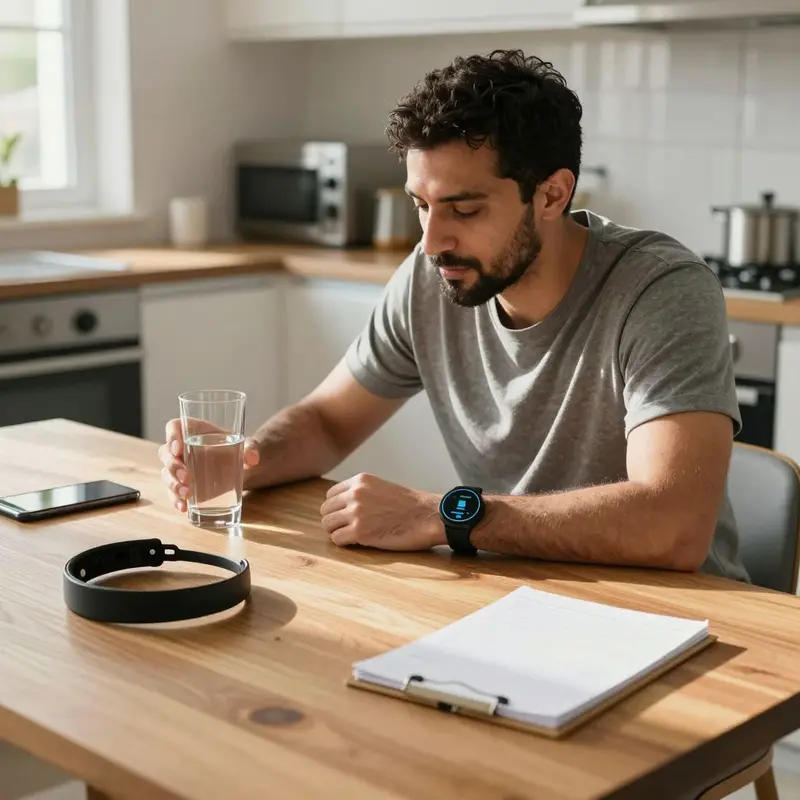
Picture the first morning with each device. With an HRV bracelet, you clip or strap it to your wrist and you’re done. The sensor sits flush against skin that’s already accustomed to wearing things. With an EEG headband, the ritual is different: dry electrodes need to seat correctly against your scalp, the band needs tension adjustment, and you’re acutely aware of wearing something on your head in a way a wristband simply never demands.
That sensory gap isn’t trivial. Setup friction doesn’t just cost you minutes; it shapes whether you’ll use a device consistently enough for the data to mean anything. HRV measurement tolerates casual compliance. You can sleep in the bracelet, forget it’s there, and still collect a meaningful overnight reading. EEG requires a degree of intentionality at every session that fundamentally changes your relationship to the habit.
Comfort compounds this over time. A wrist-worn device disappears into your day. An EEG headband sits visibly on your skull, affects how you move through social environments, and carries a cognitive overhead that has nothing to do with the brainwave data it’s collecting. For anyone who wants biometric awareness woven into ordinary life, that visibility isn’t a minor inconvenience.
The data complexity cuts the same way. Modern wearable EEG devices capture activity across two to eight channels, reading the alpha, beta, and theta frequencies that reflect attention, arousal, and mental load. That’s genuinely rich information. But interpreting it requires either dedicated software, guided sessions, or enough neurofeedback literacy to act on what the numbers suggest. HRV bracelets surface a single coherent metric, one that most people can connect directly to rest, stress, and recovery without a meaningful learning curve.
Daily usability in the EEG headband vs HRV bracelet comparison often gets framed as a feature question, but it’s really a behavioral one. The device you understand, wear without thinking, and check without dread is the device that actually changes behavior. Classification systems combining EEG attention metrics with physiological signals can reach 91% accuracy in controlled research settings. That ceiling matters very little if the setup barrier means you reach for the headband three times a week instead of every morning.
Manufacturer spec sheets don’t really cover what happens when the sensors themselves introduce noise into readings, or when the data pipeline connecting your scalp to your dashboard raises questions that have nothing to do with your stress levels at all.
Hidden health and technology dangers: When noisy signals and neural data become the risk

The noise problem isn’t abstract. When dry electrodes sit against your forehead or scalp without conductive gel, every jaw clench, head turn, and pillow shift introduces electrical interference the sensor can’t distinguish from genuine brain activity. That’s the motion artifact problem built into EEG headbands, and it’s why the data on your dashboard may not reflect what’s actually happening in your nervous system.
Compare that to how a wrist-worn HRV bracelet reads your body. PPG sensors measure the continuous pulse wave in your blood vessels, and because wrist movement follows more predictable patterns, the signal stays cleaner in real-world conditions. The accuracy gap is meaningful: PPG-based HRV wearables have demonstrated sensitivity and specificity in the 94-96% range, which means what you’re reading is almost certainly what’s happening. Consumer EEG devices, operating with far fewer channels than a clinical setup, can’t make that same claim.
There’s a subtler cost when it comes to sleep. EEG devices require maintained scalp contact to function, and that physical pressure doesn’t disappear just because you’ve closed your eyes. The contact itself can disrupt the sleep quality you’re trying to measure, creating a feedback loop where the act of monitoring degrades the very outcome you care about.
Trying to cut decision fatigue between an EEG headband and an HRV bracelet also means weighing what happens to your data after it leaves the sensor. Neural data is categorically different from heart rate data. What an EEG captures can carry implications about cognitive state, emotional response, and neurological patterns that most people haven’t considered when they unbox the device. An HRV bracelet’s CE-marked autonomic profiling sits within a well-understood regulatory category. Neural data doesn’t enjoy the same legal clarity, and most consumer EEG privacy policies haven’t caught up to the sensitivity of what they’re actually collecting.
The question isn’t just signal quality. It’s what the signal is, who holds it, and what protections govern it.
And none of this is fixed in place. The sensors are the variable, and the materials they’re built from increasingly determine both accuracy and the integrity of the data flowing from your body to your app. The next shift in wearable performance won’t come from software alone.
Material advancements: How next-gen electrodes complicate the choice
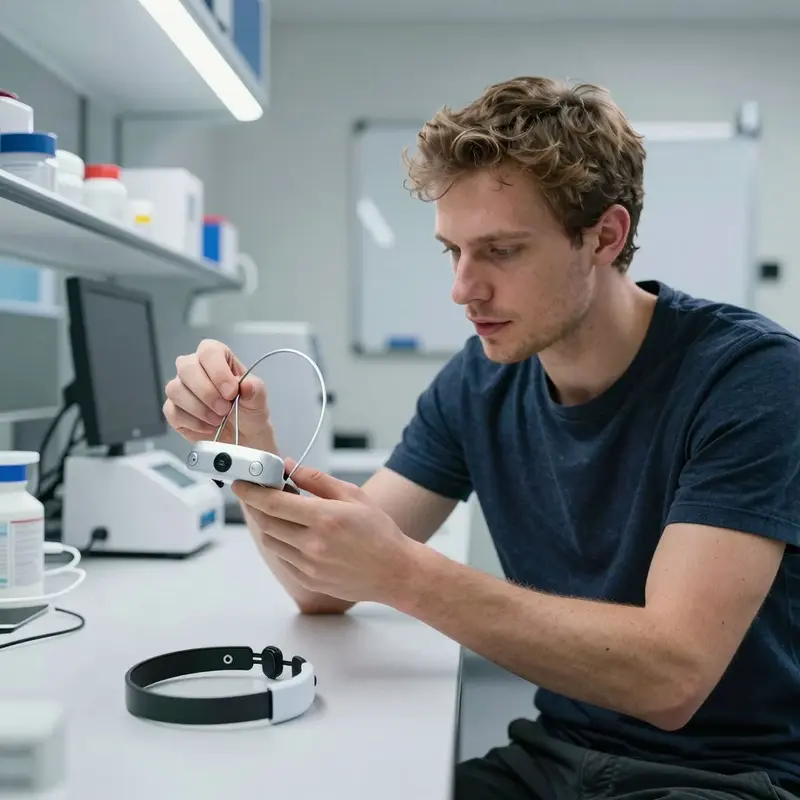
The hardware gap between what a wearable promises and what it actually delivers has always been a materials problem.
For years, EEG headbands relied on conductive gels and wet electrodes to make reliable contact with the scalp. That worked in clinical settings, but it was never going to survive the shift to everyday wearability. The solution didn’t come from better algorithms or smarter apps. It came from a new class of materials, and the difference is more consequential than most users realize.
Graphene and MXenes are the two 2D materials reshaping dry EEG electrode design. Traditional electrodes needed gel to bridge the gap between sensor and skin. These materials lower impedance at that interface directly, without adding anything sticky or inconvenient. MXene flakes, integrated into conductive hydrogels, sharpen the signal-to-noise ratio in ways older electrode materials simply couldn’t match. Graphene microtransistor arrays push that advantage further, enabling flexible neural interfaces that can capture ultra-low frequency brain activity across curved surfaces. The scalp, after all, isn’t flat.
What this means for you, practically, is that a modern EEG headband can now detect meaningful neural signals without the prep ritual that once made EEG feel clinical and exclusionary.
The reduced-channel designs made possible by these advances are worth pausing on. Some current headbands reliably detect seizure-level neural events using only 6 electrodes, down from the dozens required in traditional lab setups. That compression of capability into a minimal form factor is a direct consequence of material quality. Better signal capture per electrode means fewer electrodes needed, which means lighter, more comfortable hardware.
This is where the EEG headband vs HRV bracelet comparison gets genuinely complicated. An HRV bracelet measures a cardiovascular signal through photoplethysmography, a mature and stable technology that needs no comparable materials innovation to do its core job. EEG headbands, by contrast, are still mid-evolution. The materials are improving fast, but they come with trade-offs: wearability, skin sensitivity for some users, and the ongoing engineering tension between electrode coverage and device comfort. A headband with better materials is measurably more accurate than one without, but “better” is still relative to a baseline that HRV hardware cleared years ago.
So when you’re choosing between the two, you’re not just picking a signal. You’re also picking a point on a maturity curve, plus a set of trade-offs, and deciding whether that mix fits what you’re actually trying to learn about yourself. Get that fit right, and the device earns its place. Get it wrong, and it just occupies your wrist and your head.
Strategic outlook: Choosing the signal you’ll actually use
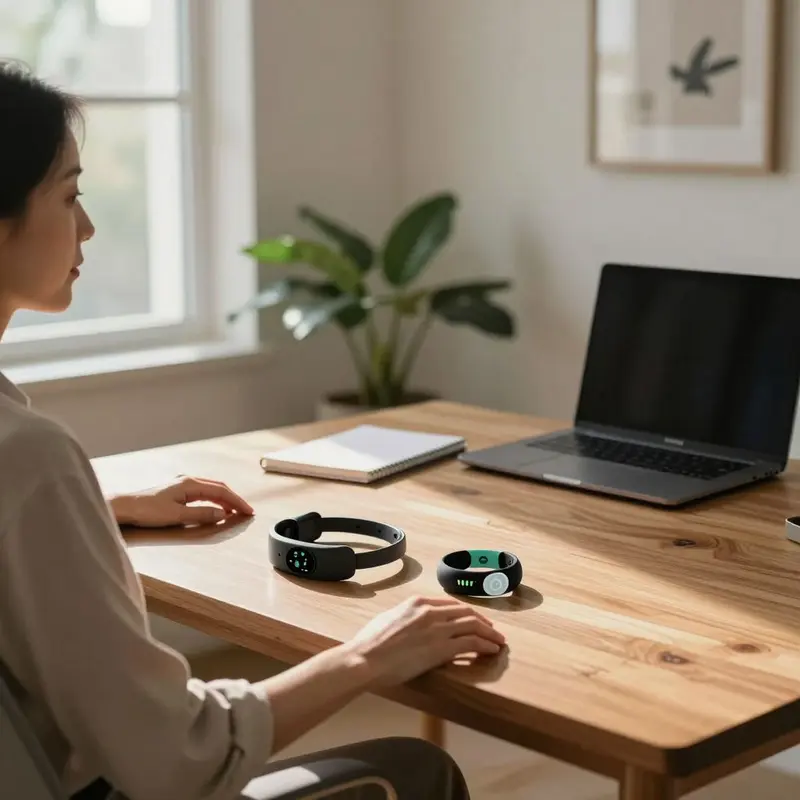
The practical answer to the EEG headband vs HRV bracelet decision comes down to what kind of self-knowledge you’re actually building toward. Not what sounds more rigorous or what looks more credible on a nightstand, but what signal maps to the question you’re asking day to day.
HRV bracelets have a structural advantage that’s easy to underestimate: they fit the rhythm of ordinary life. Because continuous wear is genuinely low-friction, the data you collect is dense, longitudinal, and honest about your arousal patterns and sleep quality in ways sporadic sessions rarely match. The picture that builds over weeks tells you things a single night’s reading can’t. That accumulation is the whole point.
EEG headbands occupy a different and narrower lane. Where HRV tracks the body’s downstream stress response, EEG reads the upstream source more directly: the neural patterns, alpha, beta, and theta waves, that describe whether your brain is alert, distracted, or sliding toward sleep. For anyone trying to understand attentional lapses, manage focus across demanding cognitive work, or monitor a condition like ADHD, that directness matters. Devices like the Muse S Athena push this further by integrating multiple physiological signals into a single feedback loop, and validation work on headbands like the Zmax has confirmed their sleep-staging credibility. The ceiling on EEG accuracy in identifying mental workload and ADHD-related patterns sits between 89 and 91 percent, which is clinically meaningful territory, not hobbyist-grade output.
The strategic lens, then, is less about which device is better and more about which blind spot you’re trying to close. If your goal is a reliable, always-on picture of how stress and recovery move through your week, HRV’s low friction is a real feature. If your goal is precision on what your brain is doing during a specific cognitive window, EEG’s signal specificity earns the inconvenience of wearing it.
Where people tend to go wrong is treating this as a capabilities contest. It isn’t. A bracelet that you actually wear every day will outperform a headband worn twice a month, regardless of what either device can theoretically measure. The honest variable isn’t technical resolution. It’s sustainable use.
Match the tool to the question, and the data stops being a scoreboard and starts being a constraint you can work with. You’re choosing the cadence you’ll live with, the kind of signal you’ll trust, and the habit you’ll keep when motivation fades.
Final thoughts
The biggest risk isn’t picking the “wrong” sensor. It’s letting a device redefine what counts as feeling okay, until your own internal signals start to sound less believable than the dashboard.
Seen that way, the real choice is about cadence and authority. The most advanced hardware in the world can still create a fragile habit if it demands perfect setup, perfect interpretation, and perfect calm. A steadier metric, worn more often, can end up being the more honest mirror. When you weigh EEG headband vs HRV bracelet, you’re not just choosing data. You’re choosing which voice gets the final say in your day.
Further reading


Leave a comment