
















No products in the cart.

Shop this story
Time for wellness-curious wearers to stop saying more metrics means health
by Elizabeth H
You bought the wearable for peace of mind. Instead, you got a wrist full of numbers that beg to be checked, compared, and judged. That uneasy loop has a name: wearable health metrics overload.
The tricky part is that the data often feels authoritative even when it isn’t actionable. A small dip can look like a warning. A “good” score can feel like permission. Over time, the device can train you to chase reassurance, not health, while quietly collecting a personal record you didn’t fully agree to manage.
Wearable metric overload as a design failure point
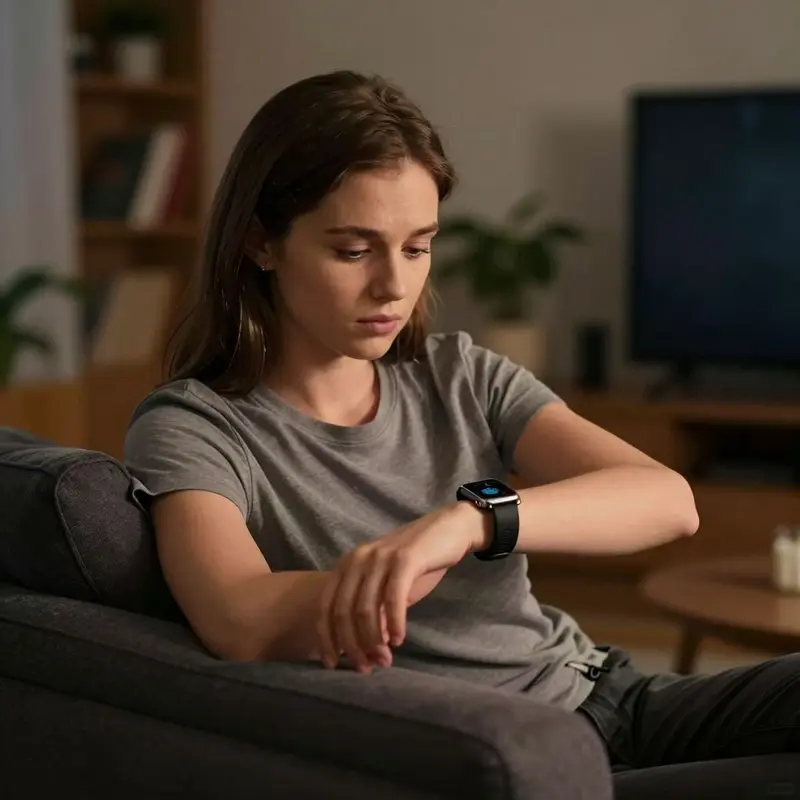
If you’ve strapped on a smartwatch to better understand your health, you’re already part of a quiet, well-meaning experiment that nobody fully designed. Wellness-curious wearers like you are a fast-growing cohort of people who aren’t patients, aren’t clinicians, and aren’t engineers, yet you’ve accepted a device onto your wrist that generates a continuous, unrelenting stream of physiological data. The promise was clarity. What arrived instead, for many, is wearable health metrics overload: a state where more data produces less understanding, not more.
The industry’s original instinct was additive: more sensors, more readings, more granularity. That instinct made a certain kind of commercial sense, but it overlooked a basic constraint: human attention is finite. When a device logs your heart rate, oxygen saturation, sleep cycles, stress scores, and step count simultaneously, the resulting picture isn’t richer. It’s noisier. Clinicians who review continuous wearable data from patients run into the same issue at scale, where the volume of incoming signals competes with the time available to interpret any of them meaningfully.
The friction points run deeper than information volume alone. Several structural challenges compound the problem for everyday wearers:
- Machine learning models embedded in wearables can misread physical movement as physiological signals, meaning a brisk walk can silently distort your stress or recovery reading without any warning.
- In real-world use outside controlled settings, battery depletion introduces gaps in the data stream, degrading reading quality without ever flagging the error to you.
- Older adults, a demographic with genuine health-monitoring needs, frequently hesitate to adopt smartwatches because the interfaces feel unnecessarily complex, creating a gap between the people who need this technology most and those actually using it.
These aren’t edge cases. They’re predictable, systemic failures that stay invisible inside what looks like a seamless tracking experience.
The good news is that the field is beginning to correct itself. AI and user-centered design are shifting the conversation from data collection toward data relevance, asking not “what can we measure?” but “what does this measurement mean for this person, right now?” Approaches that combine multiple data streams are showing particular promise for targeted evaluation rather than broad-spectrum surveillance, pointing toward a model where your device surfaces a timely answer to a specific question rather than handing you a raw archive.
A wearable that earns a permanent place on your wrist won’t win by tracking the most. It’ll win by knowing when to speak up and, just as importantly, when to stay quiet. That shift raises a tougher test: not whether wearables can collect useful health data, but whether the health system is ready to act on it.
Diagnostic dominance: When wearables outpace the health system

The health system’s readiness isn’t hypothetical anymore. Across clinical research and early deployment programs, AI-integrated wearables have demonstrated diagnostic accuracy strong enough to warrant real attention, spotting early warning signs that would’ve previously required a clinic visit, a waiting room, and a specialist’s calendar. That’s not incremental. It’s a structural shift in where health intelligence begins.
What makes wearables stick, both for you and for the clinicians who might act on your data, comes down to what researchers call task-technology fit: the degree to which a tool matches the specific demands of the job it’s meant to do. When a wearable lines up tightly with a genuine health need, adoption follows. When it doesn’t, even the most technically impressive device sits in a drawer. Performance expectancy drives healthcare tech uptake more than novelty or features alone, which means the wearables that earn consistent use are the ones that give you a clear, believable reason to trust them.
That trust is still being tested at the system level. Regulatory friction and data quality inconsistencies remain real obstacles, not just bureaucratic inconveniences. Policy frameworks in many markets have opened the door to remote health management using wearables, and the theoretical cost savings are significant enough to attract serious institutional interest. But rigorous trials validating those savings at scale are still sparse. The gap between “this could work” and “this has been proven to work in a healthcare system” is wider than the marketing suggests.
This is where wearable health metrics overload becomes a structural problem, not just a personal annoyance.
When a device surfaces too many signals without clinical context, the data doesn’t help clinicians. It adds noise to a system that already struggles with signal. The most diagnostically capable wearable means nothing if the health infrastructure it feeds into isn’t equipped to triage what it receives.
You’re in a genuinely interesting position: the technology has outpaced the system built to receive it. Your device can flag anomalies with accuracy that would’ve seemed implausible a decade ago, but the pathway from that flag to a clinical decision is still being constructed, regulation by regulation, trial by trial. Underneath all that infrastructure-building sits a question nobody’s fully resolved yet: who controls the data being collected, and what happens to it once it leaves your wrist.
Privacy vs. utility: When health data stops being harmless

Picture the moment your smartwatch syncs. In the span of a second, your resting heart rate, sleep stages, blood oxygen readings, and step count travel from your wrist to a server you’ve never seen, governed by a privacy policy you almost certainly haven’t read in full. That transaction happens dozens of times a day, and most people wearing the device have only the vaguest sense of where that data goes next.
This is where wearable health metrics overload stops being just a cognitive problem and becomes a structural one. It isn’t only that you’re drowning in numbers you can’t act on. It’s that generating those numbers at scale creates privacy vulnerabilities that are genuinely hard to resolve, even when the intentions behind the technology are good.
The failure points cluster in predictable places:
- Anonymization techniques applied to your health data can be reversed. Stripping your name from a dataset doesn’t make it anonymous when your movement patterns, sleep rhythms, and heart rate signature are as individually distinct as a fingerprint.
- When smartwatch data gets pulled into electronic health records, questions of ownership get murky fast. Your doctor’s system, your insurer’s platform, and the device manufacturer’s cloud may all hold overlapping copies, with no single authority determining who can share what.
- Emerging approaches that process data locally on the device rather than in the cloud still carry risk. Security researchers have demonstrated that these systems can be probed in ways that expose personal information indirectly.
What ties these vulnerabilities together is a trust gap the industry hasn’t closed. Fewer than half of users intend to adopt personal electronic health records, and confidentiality fears sit at the center of that hesitation. That reluctance isn’t irrational. It reflects a reasonable read of a situation where the people collecting your data and the people protecting it are often the same entity.
You’re not wrong to feel uncertain about who owns your health story once it leaves your body. The discomfort you feel scrolling through metric after metric isn’t just fatigue. It’s an intuition that the value exchange hasn’t been fully explained to you, because it genuinely hasn’t.
Machine intelligence is now being asked to manage that gap on your behalf. How well it does will decide whether wearables become a genuine health tool, or stay a sophisticated data collection business with wellness branding.
AI in wearables: From more numbers to meaning

The answer, so far, is partial. AI is being integrated into wearables not to give you more data, but to do something the devices never managed alone: decide which data actually matters to you, right now, in your specific context. That distinction sounds subtle. It isn’t.
The technical shift enabling this is called edge computing, which means analysis happens on the device itself, rather than being routed through a remote server. For you, that translates to two things that matter in practice: faster insights and meaningfully fewer privacy risks. Your health data doesn’t have to leave your wrist to be useful. That’s not a minor convenience upgrade. It’s a structural change in who controls the information your body generates.
But the harder problem isn’t processing speed. It’s fragmentation. Your sleep score, your stress reading, your heart rate variability, your activity rings, these data streams rarely speak to each other inside the device, and wearable health metrics overload is partly a design failure, but it’s also a reflection of how genuinely difficult it is to synthesize biological signals into one coherent picture. AI is being asked to solve that integration problem, and the most credible versions of it do so with clinician oversight built in, not bolted on afterward.
What you should be watching for is whether the AI layer actually explains itself. An insight you can’t interrogate is just another number dressed in confidence. The systems earning trust right now are the ones that can tell you not just what your data suggests, but why that suggestion follows from your specific pattern. That transparency isn’t a nice feature. It’s the entire basis for using an insight to make a real decision.
The clearest application emerging from all of this is chronic disease management, where the stakes are high enough that vague wellness nudges simply aren’t acceptable. For someone managing a condition where a meaningful shift in baseline could precede symptoms by hours or days, an AI layer paying genuine attention to that drift could be consequential in ways no step count ever was.
So when you glance at your device, don’t just notice what it says. Notice what it seems designed to pull you toward: steadier health, or more checking. Those two can look identical from the outside, right up until they don’t.
Final thoughts
The big shift isn’t that wearables can measure more. It’s that they’re starting to shape what you believe health is, by turning daily life into a stream of scores that can steer choices, moods, and trust.
So the real standard for a “smart” wearable can’t be sensor count or prettier charts. It’s restraint, with receipts. When the device speaks, it should explain itself in plain language, and when it’s unsure, it should stay quiet. If it can’t do that, wearable health metrics overload isn’t a user problem. It’s the product telling you it still doesn’t know what matters.
Further reading


Leave a comment